Type: Limited edition prints
Size: 48cm x
Tirage: 100 prints
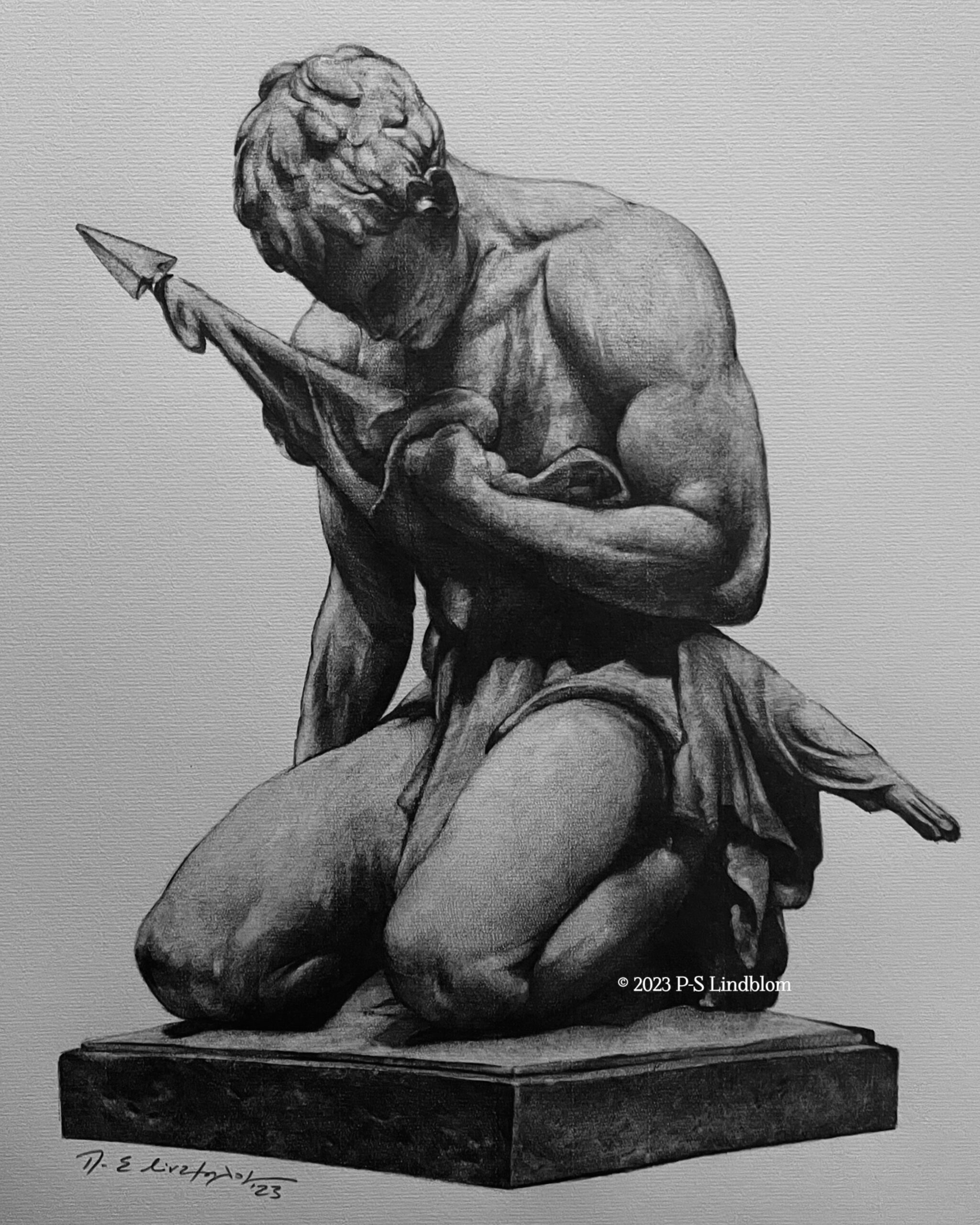
A pencil drawing of “The Monument to the Fallen Railwaymen" (German; Denkmal für die gefallenen Eisenbahner), created by German sculptor Emil Cauer.
First unveiled in 1928 at Invalidenstraße in the courtyard of the former "Royal Museum of Transport and Construction" at the Hamburger Bahnhof (now the Museum für Gegenwart).
It now stands on display at the exhibition: "Uncovered. Berlin and its Monuments" ("Enthuellt. Berlin und seine Denkmaeler") at the Spandau citadel since April 29, 2016 in Berlin, Germany.
Depicts a warrior, on his knees, absorbed in himself, completely withdrawn and worn out after a battle. Holding with his left hand to his chest a flag on a spear headed broken pole.
Following the ideal figure of ancient models, the naked, athletic body of the warrior is muscularly modeled.
A typical example of the monument culture of the Weimar Republic. After the end of the First World War, memorials for the more than two million German soldiers who died were erected throughout Berlin.
Emil Cauer the Younger (1867-1946) was a German sculptor, known for his monuments and fountains in Berlin. He was named a Professor by Grand Duke Ernst Ludwig in 1916.
Other notable works by Cauer include two prominent fountains; the "Erika-Brunnen", on the Adam-Kuckhoff-Platz in the Wilmersdorf district (destroyed in 1943), and the Neo-Baroque style "Siegfried-Brunnen", a sandstone sculpture on the Rüdesheimer Platz, also in Wilmersdorf.