Type: Limited edition prints
Size: 48cm x 33cm / 65cm x 50cm
Tirage: 50 copies each
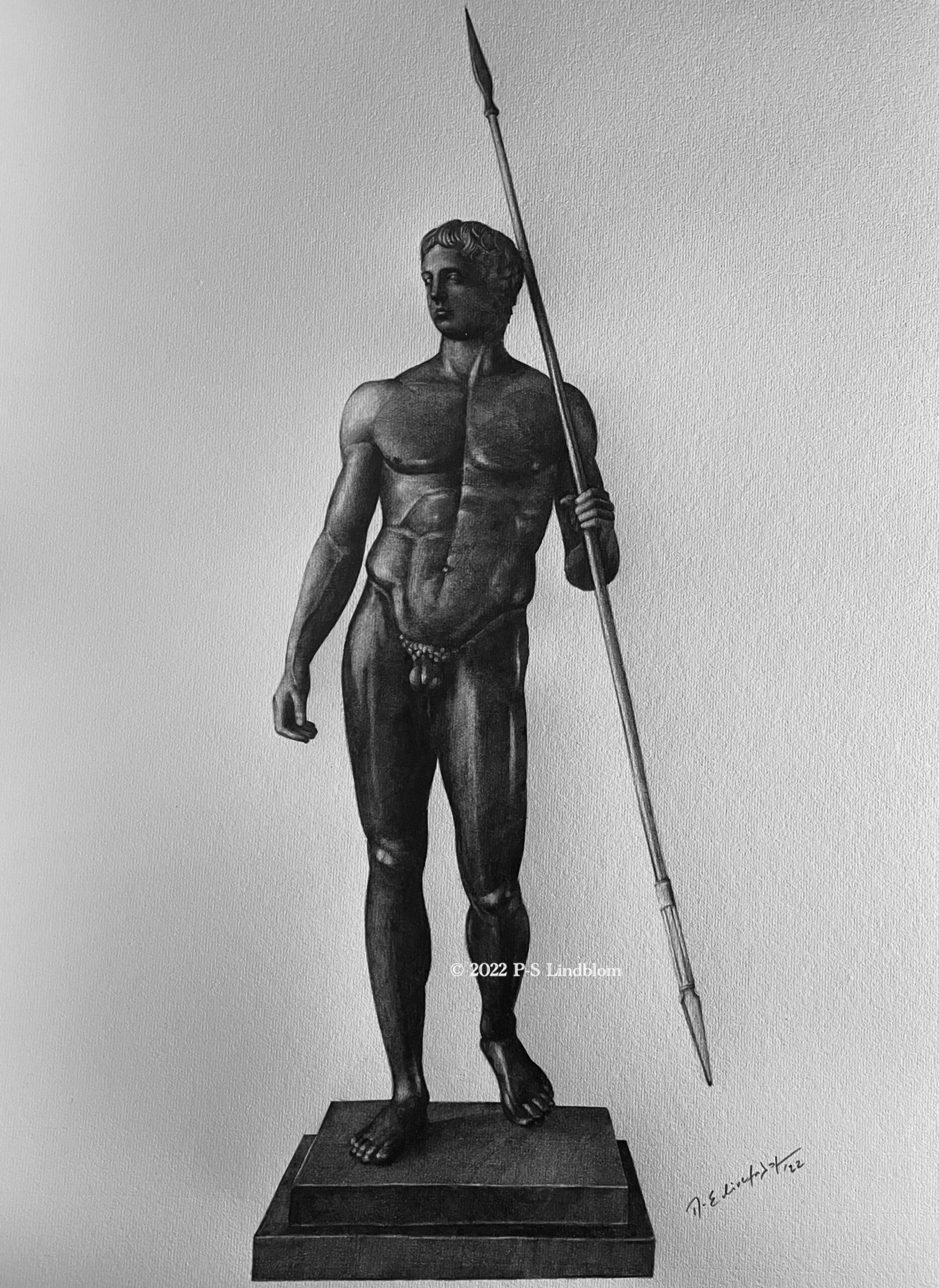
A pencil drawing of The Doryphoros (Greek : Δορυφόρος “Spear-Bearer") of Polykleitos, one of the best known Greek sculptures of Classical antiquity, depicting a solidly built, muscular, standing warrior, bearing a spear balanced on his left shoulder.
A reconstruction by Georg Roemer created in 1920, unfortunately destroyed during the Second World War in 1944.
Rendered somewhat above life-size, 212 cm high, the lost bronze original of the work would have been cast circa 440 BC, but it is today known only from later Roman marble copies. The work nonetheless forms an important early example of both Classical Greek contrapposto and classical realism; as such, the iconic Doryphoros proved highly influential elsewhere in ancient art.
The renowned Greek sculptor Polykleitos designed a sculptural work as a demonstration of his written treatise, entitled the Κανών (or 'Canon'), translated as "measure" or "rule"), exemplifying what he considered to be the perfectly harmonious and balanced proportions of the human body in the sculpted form.
Polykleitos used distinct proportions when creating this work; for example, the ratio of head to body size is one to seven. The figure's head turned slightly to the right, the heavily-muscled but athletic figure of the Doryphoros is depicted standing in the instant that he steps forward from a static pose. This posture reflects only the slightest incipient movement, and yet the limbs and torso are shown as fully responsive.
The left hand held a long spear; the left shoulder (on which the spear originally rested) is depicted as tensed and therefore slightly raised, with the left arm bent and tensed to maintain the spear's position. The figure's pose is classical contrapposto, most obviously seen in the angled positioning of the pelvis. The figure's right leg is straightened, depicted as supporting the body's weight, with the right hip raised and the right torso contracted. The left leg bears no weight and the left hip drops, slightly extending the torso on the left side. The right arm hangs positioned by the figure's side, bearing no load.