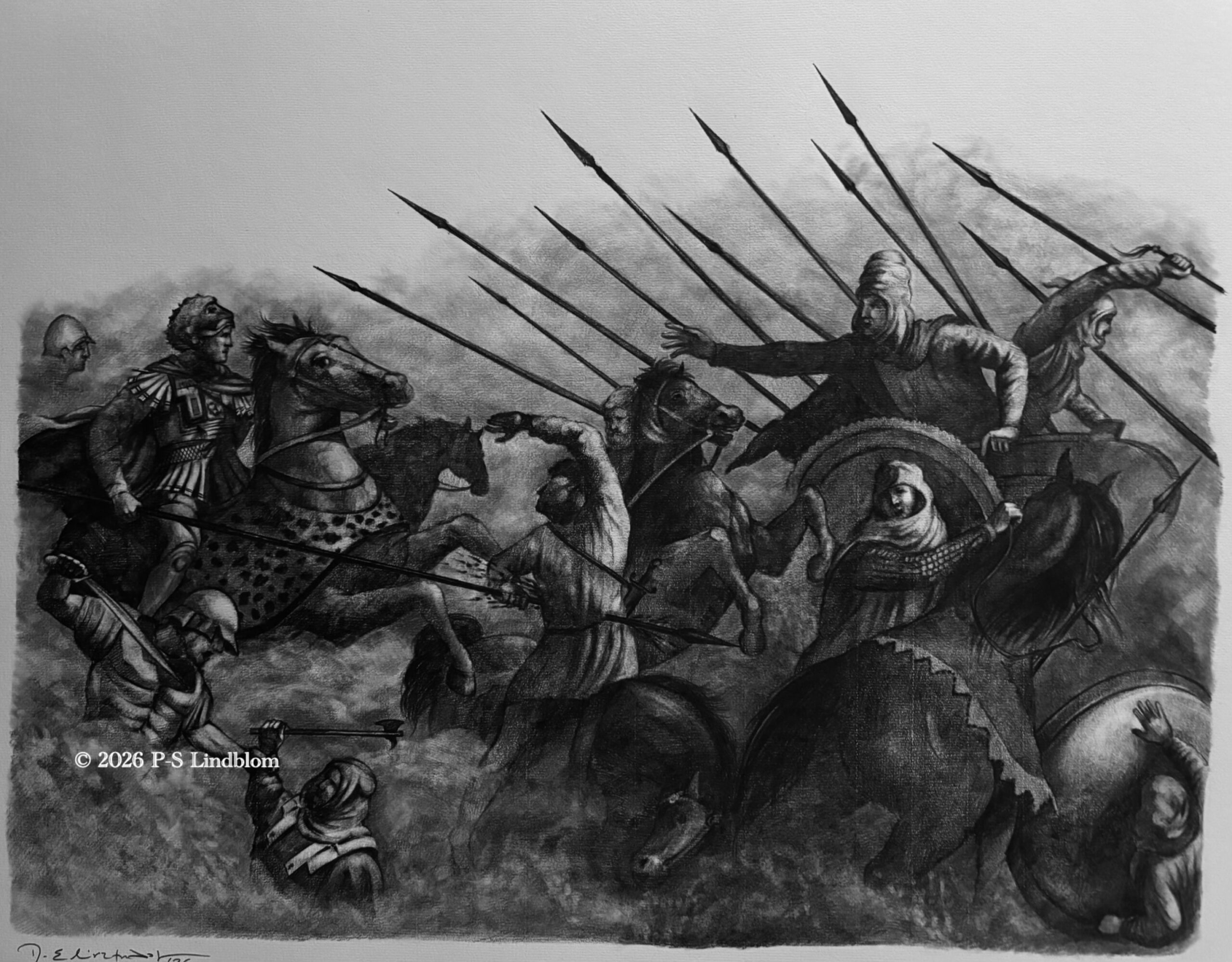
Type: Limited edition prints
Size: 33cm x 48cm
Tirage: 100 copies
A pencil drawing of a remastered digital depiction of the historical Alexander Mosaic.
The Alexander Mosaic, also known as the Battle of Issus Mosaic, is a Roman floor mosaic originally from the House of the Faun in Pompeii, now preserved in the National Archaeological Museum, Naples.
The Battle of Issus (also Issos) occurred in southern Anatolia, on 5 November 333 BC between the Hellenic League led by Alexander the Great and the Achaemenid (or Persian) Empire, led by Darius III.
It was the second major battle in Alexander’s invasion of the Persian empire, and the first encounter between Darius Ill and Alexander the Great. The battle resulted in the Macedonian troops defeating the Persian forces. Darius was forced to flee, leaving behind his family and treasury which were captured by Alexander the Great.
On the left side of the mosaic, Alexander of Macedonia is seen in a profile view facing right. He is posed in action with his lance in his right arm. Alexander wears a linen breastplate, or linothorax, with the head of the Gorgon Medusa, the traditional emblem of Athena, and he rides his horse Bucephalus. Alexander’s gaze is trained on Darius.
Darius Ill is reaching out to the dying soldier, while another soldier tries to get the king’s chariot out of the battle scene. At this precise moment, Darius is making the order, because the Persian spears are still pointed in the direction of the Macedonians, and the king is riding in a chariot being wheeled around.
Darius and his charioteer take up a large portion of the right half of the mosaic. There are various precarious elements surrounding him. In the background Darius’ charioteer whips the horses to flee from the battle scene. There is visible fear and anxiety in the Persian king’s face, seen especially in his furrowed brows and deep frown.
Darius is positioned holding a bow in his left hand while his right arm is outstretched toward Alexander.
Darius’ brother Oxyathres is also portrayed, sacrificing himself to save the king directly in front of the king’s chariot, holding the reins to his horse.