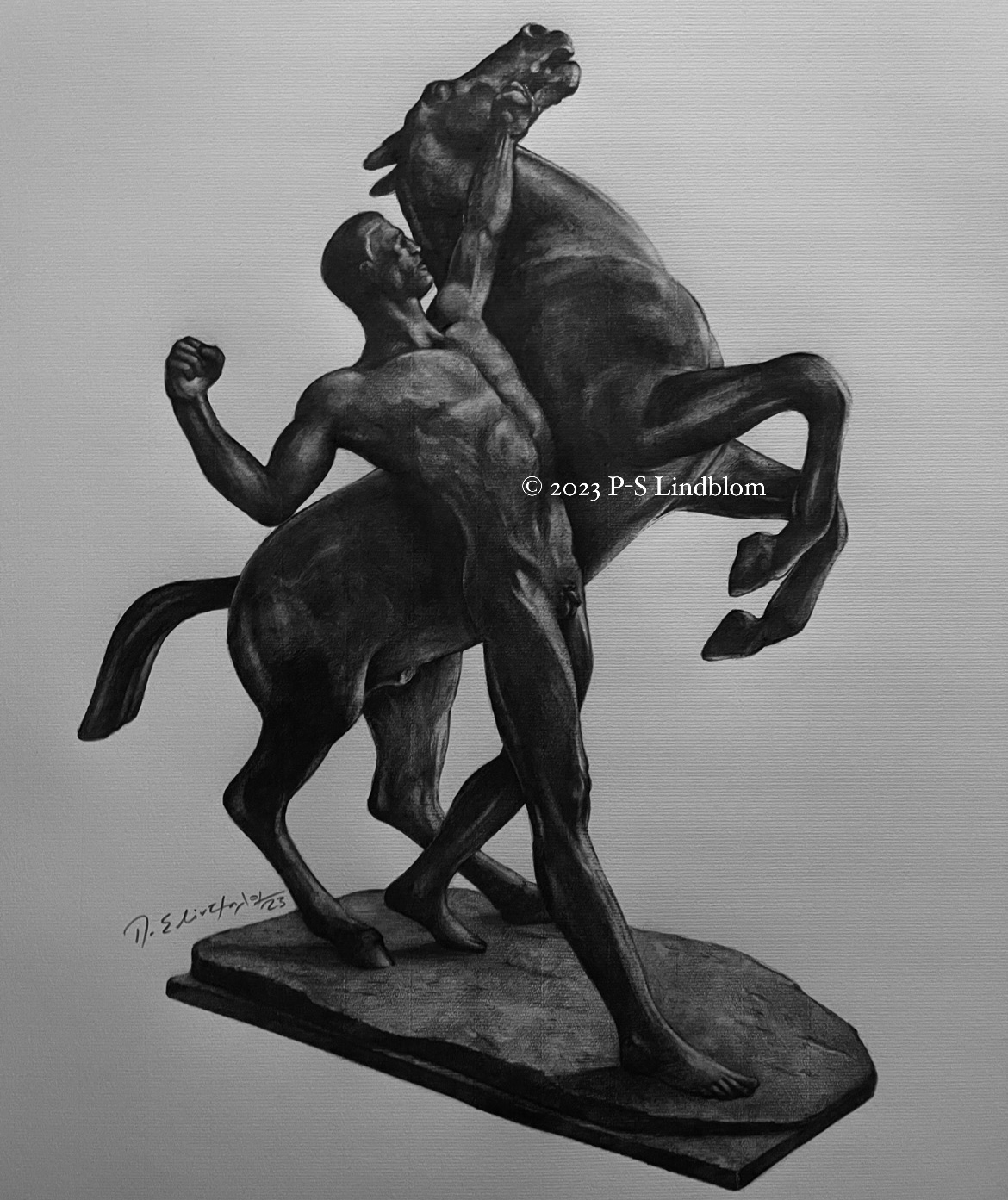
Type: Limited edition prints
Size: 48cm x 33cm
Tirage: 100 copies
A pencil drawing of an extremely rare patinated statuette of “Alexander der große zähmt Bukephalus” / “Alexander the Great taming Bucephalus.”
The sculpture depicts a nude young man restraining and holding back a rearing unbridled horse. In many photos dated back from the late 1930’s and early 1940’s, plaster models in various sizes can be seen in the artist’s studio. Also a similar relief of the "Bändigung" / “Taming” was made for the "Triumphbogen.”
One can bring in mind the similarities with the Marly horses by Guillaume Coustou, now in the Louvre. They share the same great dynamic energy with Breker’s amazing statue.
In 1979 Breker created a pair of two identical horses, variation A / Bucephalus A (on a flat base) and variation B / Bucephalus B (on a higher base). These were reproduced in patinated bronze, in a tirage of 300 copies, 29 cm high, which later found their way in many private collections and auctions.
Bucephalus or Bucephalas (Greek ; Βουκεφάλας; c. 355 BC – June 326 BC) was the horse of Alexander the Great, and one of the most famous horses of classical antiquity.
Plutarch says in 344 BC, at twelve or thirteen years of age, Alexander of Macedonia won the horse by making a wager with his father: A horse dealer named Philonicus the Thessalian offered Bucephalus to King Philip II for the remarkably high sum of 13 talents. Because no one could tame the animal, Philip was not interested. However, Alexander was, and he offered to pay himself should he fail.
Alexander was given a chance and surprised all by subduing it. He spoke soothingly to the horse and turned it toward the sun so that it could no longer see its own shadow, which had been the cause of its distress. Dropping his fluttering cloak as well, Alexander successfully tamed the horse.
As one of his chargers, Bucephalus served Alexander in numerous battles.
Arrian states, with Onesicritus as his source, that Bucephalus died at the age of thirty. Other sources, however, give as the cause of death not old age or weariness, but fatal injuries at the Battle of the Hydaspes (June 326 BC), in which Alexander's army defeated King Porus. Alexander promptly founded a city, Bucephala, in honour of his horse. It lay on the west bank of the Hydaspes river (modern-day Jhelum in Pakistan). The modern-day town of Jalalpur Sharif, outside Jhelum, is said to be where Bucephalus is buried.