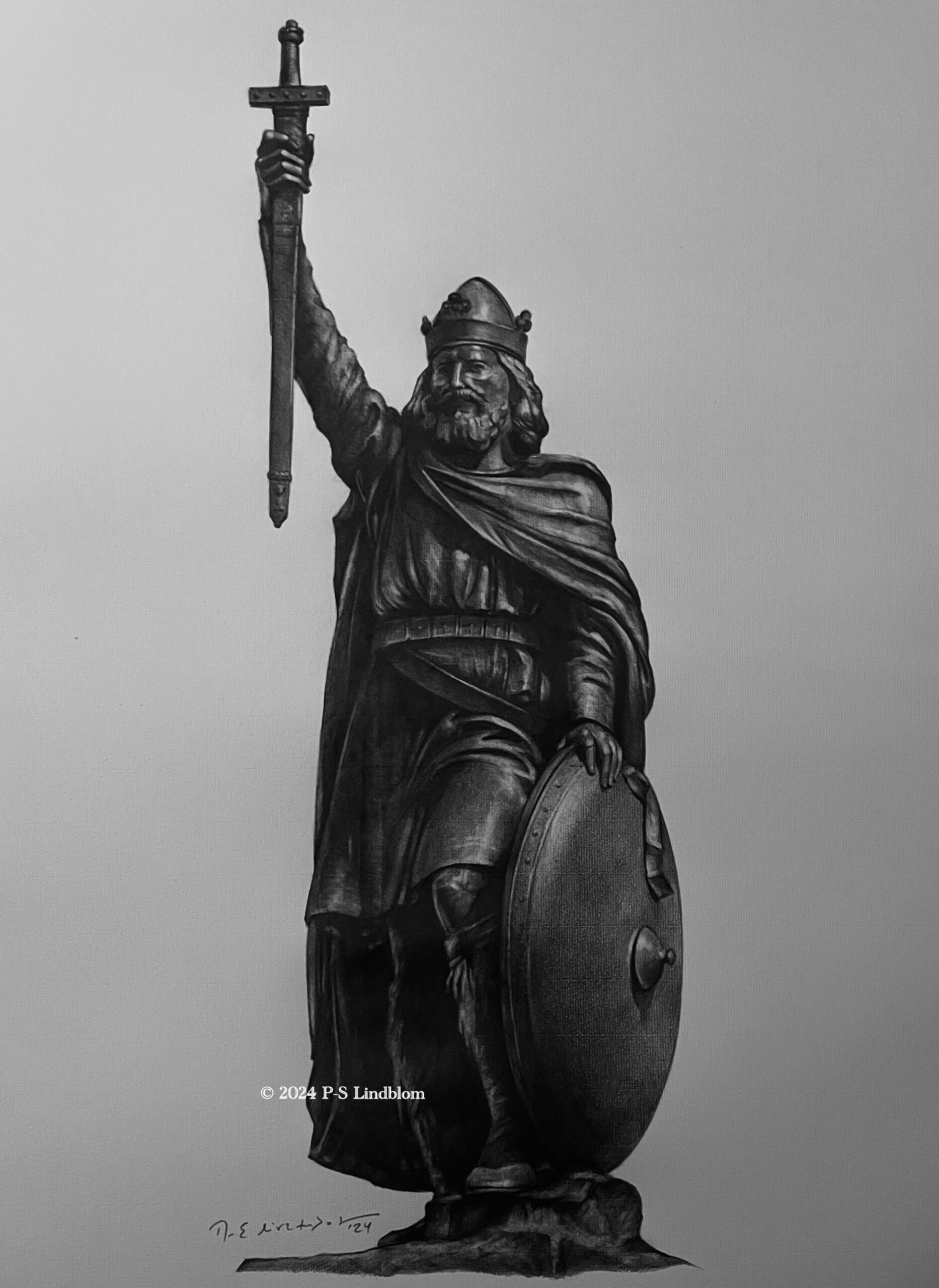
Type: Limited edition prints
Size: 48cm x 33cm
Tirage: 100 copies
A pencil drawing of Alfred the Great (849-899), the founder of the kingdom and nation. A statue designed by Sir W. Hamo Thornycroft, R. A. (1850-1925), cast in bronze by Singer & Sons of Frome and erected in 1901 to mark one thousand years since Alfred’s death, standing close to the site of Winchester’s medieval East Gate, the ancient capital of Wessex.
In September 1901, Winchester was the focus of celebrations marking the Millenary of King Alfred’s death. The high point of the festivities was the unveiling of this huge monument, prominently located in front of the site of the city’s old East Gate. Reporting the unveiling, the New York Times described the work as “one of the largest single figures in bronze ever produced in the United Kingdom. From the base to the tip of the upraised arm measures seventeen feet. The sheathed sword is detachable, and somewhat increases the height. All the rest of the statue is in one casting. The statue is placed on a pedestal consisting of two immense blocks of gray Cornish granite, each block weighing no less than four to six tons.”
The public to whom Alfred was a national icon — his status as “the founder of the kingdom and nation” is recorded on a plaque on the base — approved. The Times correspondent , for instance, was full of praise for this “Alfred breathing life and radiating energy” (qtd. in Parker 13). The way he held his sword, “effectively recalling the religious principles that had underpinned [his] wars,” was especially admired (Parker 13).
Alfred the Great (Ælfred; c. 849 – 26 October 899) was King of the West Saxons from 871 to 886, and King of the Anglo-Saxons from 886 until his death in 899. He was the youngest son of King Æthelwulf and his first wife Osburh, who both died when Alfred was young. Three of Alfred’s brothers, Æthelbald, Æthelberht and Æthelred, reigned in turn before him. Under Alfred’s rule, considerable administrative and military reforms were introduced, prompting lasting change in England.
After ascending the throne, Alfred spent several years fighting Viking invasions.
He won a decisive victory in the Battle of Edington in 878 and made an agreement with the Vikings, dividing England between Anglo-Saxon territory and the Viking-ruled Danelaw, composed of Scandinavian York, the north-east Midlands and East Anglia. Alfred also oversaw the conversion of Viking leader Guthrum to Christianity. He defended his kingdom against the Viking attempt at conquest, becoming the dominant ruler in England.