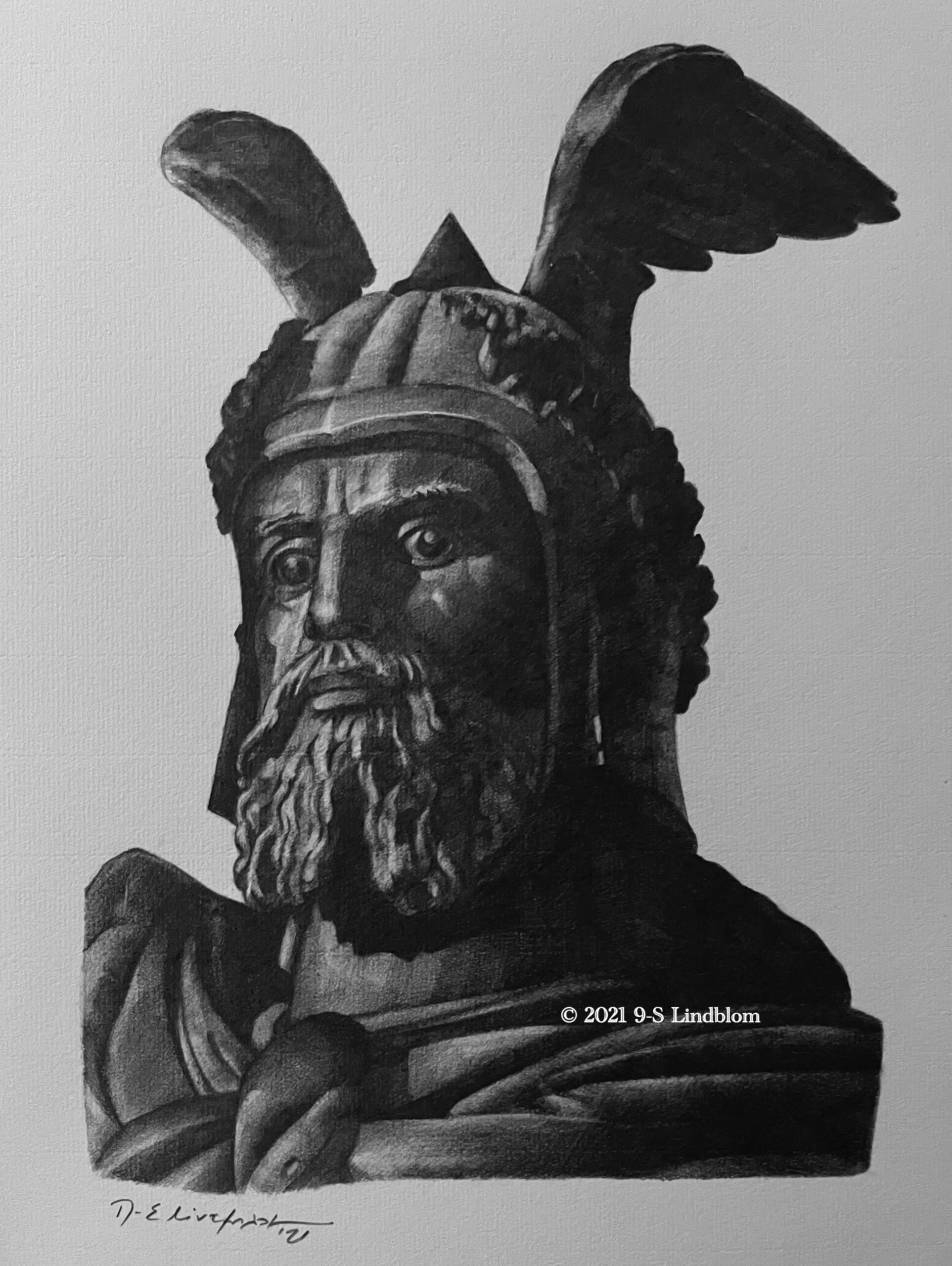
Type: Limited edition prints
Size: 48cm x 33cm
Tirage: 50 copies
A pencil drawing (detail) of The Hermannsdenkmal (Hermann’s Monument) a monument located southwest of Detmold, in Germany. It stands on the densely forested Grotenburg, sometimes also called the Teutberg or Teut, a hill (elevation 386 m) in the Teutoburger Wald (Teutoburg Forest) range.
Arminius (German: Hermann; 18/17 BC – 21 AD)a Roman officer and later chieftain of the Germanic Cherusci tribe who is best known for commanding an alliance of Germanic tribes at the Battle of the Teutoburg Forest in 9 AD, in which three Roman legions under the command of general Publius Quinctilius Varus were destroyed.
His victory at Teutoburg Forest would precipitate the Roman Empire's permanent strategic withdrawal from Germania Magna.
Modern historians have regarded Arminius' victory as one of Rome's greatest defeats. As it prevented the Romanization of Germanic peoples east of the Rhine, it has also been considered one of the most decisive battles in history, and a turning point in world history.
Born a prince of the Cherusci tribe, Arminius was part of the Roman friendly faction of the tribe. He learned Latin and served in the Roman military, which gained him Roman citizenship and the rank of eques. After serving with distinction in the Great Illyrian Revolt, he was sent to Germania to aid the local governor Publius Quinctilius Varus in completing the Roman conquest of the Germanic tribes. While in this capacity, Arminius secretly plotted a Germanic revolt against Roman rule, which culminated in the ambush and destruction of three Roman legions in the Teutoburg Forest.
In the aftermath of the battle, Arminius fought retaliatory invasions by the Roman general Germanicus in the battles of Pontes Longi, Idistaviso, and the Angrivarian Wall, and deposed a rival, the Marcomanni king Maroboduus. Germanic nobles, afraid of Arminius' growing power, assassinated him in 21 AD. He was remembered in Germanic legends for generations afterwards.