Type: Limited edition prints
Size: 48cm x 33cm / 65cm x 50cm
Tirage: 50 copies each
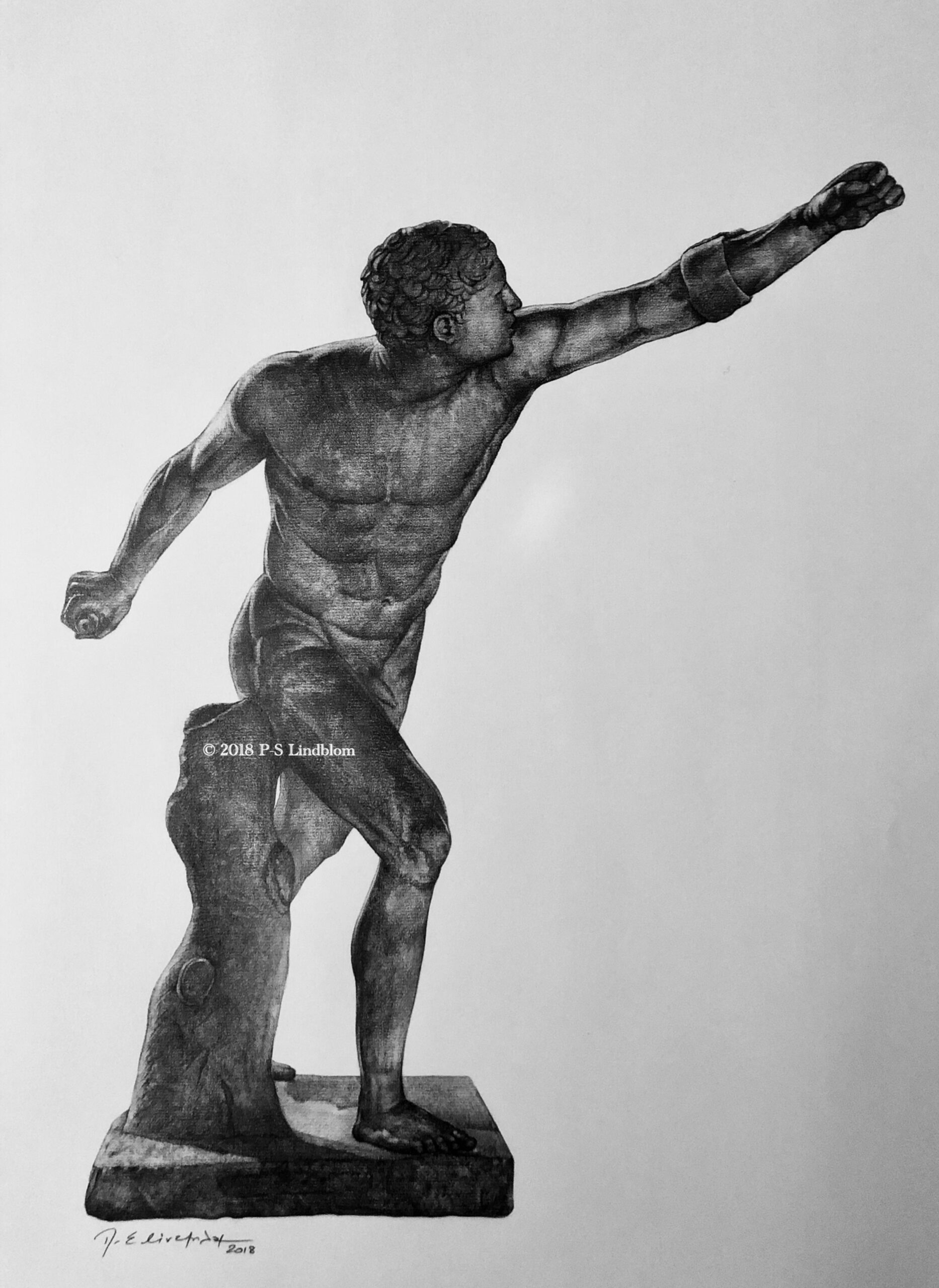
A pencil drawing of The Borghese Gladiator, a Hellenistic life-size marble sculpture portraying a swordsman, created at Ephesus about 100 BC.
Depicts a warrior, plunging forward, left arm extended upwards with remains of shield on forearm. Head facing left, right arm down and behind, hilt of sword in right hand.
The sculpture is signed on the pedestal by Agasias, son of Dositheus, who is otherwise unknown. It is not quite clear whether the Agasias who is mentioned as the father of Heraclides is the same person. Agasias, son of Menophilus may have been a cousin.
It was found before 1611, in the present territory of Anzio south of Rome, among the ruins of a seaside palace of Nero on the site of the ancient Antium. From the attitude of the figure it is clear that the statue represents not a gladiator, but a warrior contending with a mounted combatant. In the days when antique sculptures gained immediacy by being identified with specific figures from history or literature, Friedrich Thiersch conjectured that it was intended to represent Achilles fighting with the mounted Amazon, Penthesilea.
The sculpture was added to the Borghese collection in Rome. At the Villa Borghese it stood in a ground-floor room named for it, redecorated in the early 1780s by Antonio Asprucci. Camillo Borghese was pressured to sell it to his brother-in-law, Napoleon Bonaparte, in 1807; it was taken to Paris when the Borghese collection was acquired for the Louvre, where it now resides.
Misnamed a gladiator due to an erroneous restoration, it was among the most admired and copied works of antiquity in the eighteenth century, providing sculptors a canon of proportions.