Type: Limited edition prints
Size: 33cm x 48cm / 50cm x 65cm
Tirage: 50 copies each
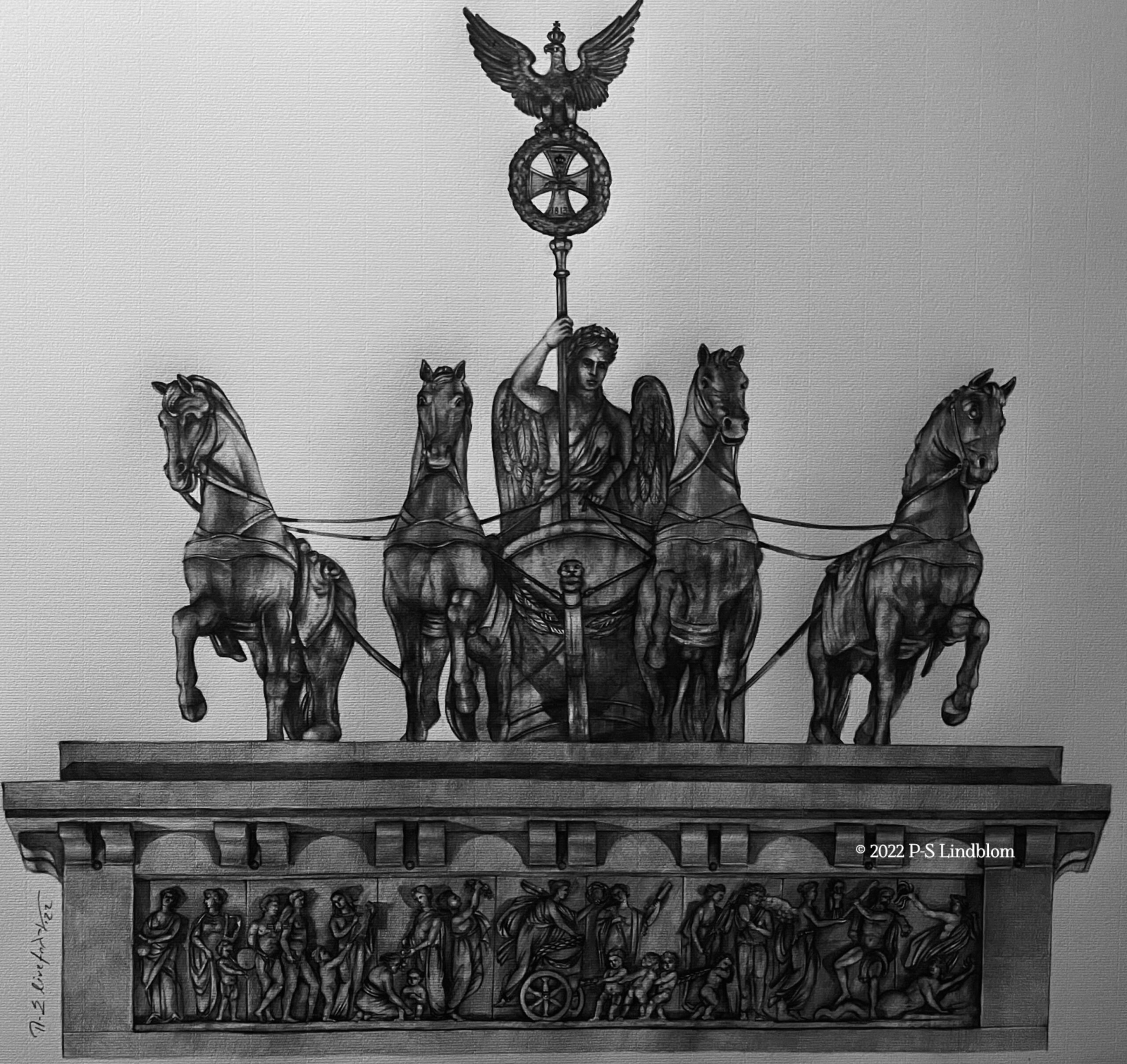
A pencil drawing of the Quadriga (a chariot pulled by four horses) sculpture on top of The Brandenburg Gate.
The sculpture, depicting a two-wheeled chariot pulled by four horses running side by side, was meant to symbolize peace entering the city. The horses' reins are held by Victoria, the goddess of victory.
The Brandenburg Gate (German: Brandenburger Tor) is an 18th-century neoclassical monument in Berlin, built between 1788 and 1791 based on designs by Carl Gotthard Langhans the Elder, who was strongly inspired by the Propylaea of the Athenian Acropolis.
Built on the orders of Prussian king Frederick William II after restoring the Orangist power by suppressing the Dutch popular unrest. One of the best-known landmarks of Germany, it was built on the site of a former city gate that marked the start of the road from Berlin to the town of Brandenburg an der Havel, which used to be the capital of the Margraviate of Brandenburg.
Two years after the Brandenburg Gate was completed, the Quadriga was placed on top of the Brandenburg Gate by Johann Gottfried Schadow in 1793.
Over the course of time, the sculpture was taken down from the Brandenburg Gate a total of three times. After the defeat of Prussia in 1806, Napoleon took the Quadriga to Paris.
However, the victory of the Alliance allowed it to be brought back and put back in its old place eight years later.
During the Second World War, the Brandenburg Gate and the Quadriga were severely damaged by bombing. The sculpture therefore had to be disposed of in 1956 in the course of the reconstruction of the gate and replaced by a copy.