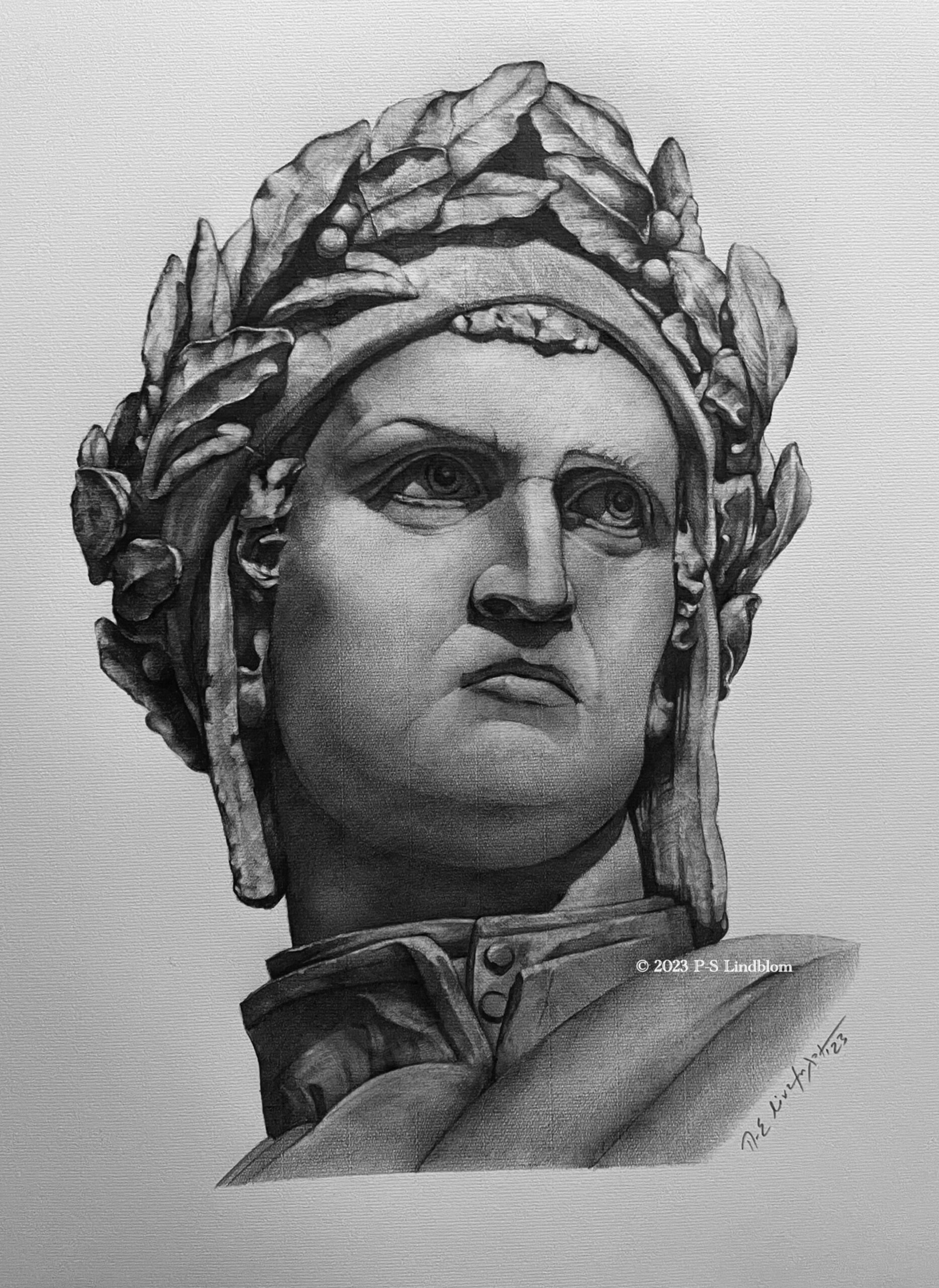
Type: Limited edition prints
Size: 48cm x 33cm
Tirage: 50 copies
A pencil drawing of a detail of “The Statue of Dante Alighieri” (Italian: Monumento a Dante Alighieri) a monument to Dante Alighieri in Piazza Santa Croce, outside the Basilica of Santa Croce, in Florence, Italy.
The statue was erected in 1865 to celebrate the 600th anniversary of Dante's birth. It is the work of the sculptor Enrico Pazzi and the pedestal was designed by Luigi del Sarto.
At his feet, a Roman eagle symbolizes the arising from the ashes of the fallen Roman Empire. The pedestal has four Marzocco lions with shields holding the names of minor works by Dante and the symbols of various Italian cities who contributed to the cost of the sculpture.
Dante Alighieri (c. 1265 – 14 September 1321), probably baptized Durante di Alighiero degli Alighieri and often referred to as Dante, an Italian poet, writer and philosopher.
He is described as the "father" of the Italian language, and in Italy he is often referred to as il Sommo Poeta ("the Supreme Poet"). Dante, Petrarch, and Boccaccio are also called the tre corone ("three crowns") of Italian literature.
His Divine Comedy, originally called Comedìa (modern Italian: Commedia) and later christened Divina by Giovanni Boccaccio, is widely considered one of the most important poems of the Middle Ages and the greatest literary work in the Italian language.
It is divided into 3 sections: Inferno, Purgatorio, and Paradiso. Each one of these sections is divided into 33 cantos (except Inferno, which has 34 cantos), which are written in tercets (groups of 3 lines).