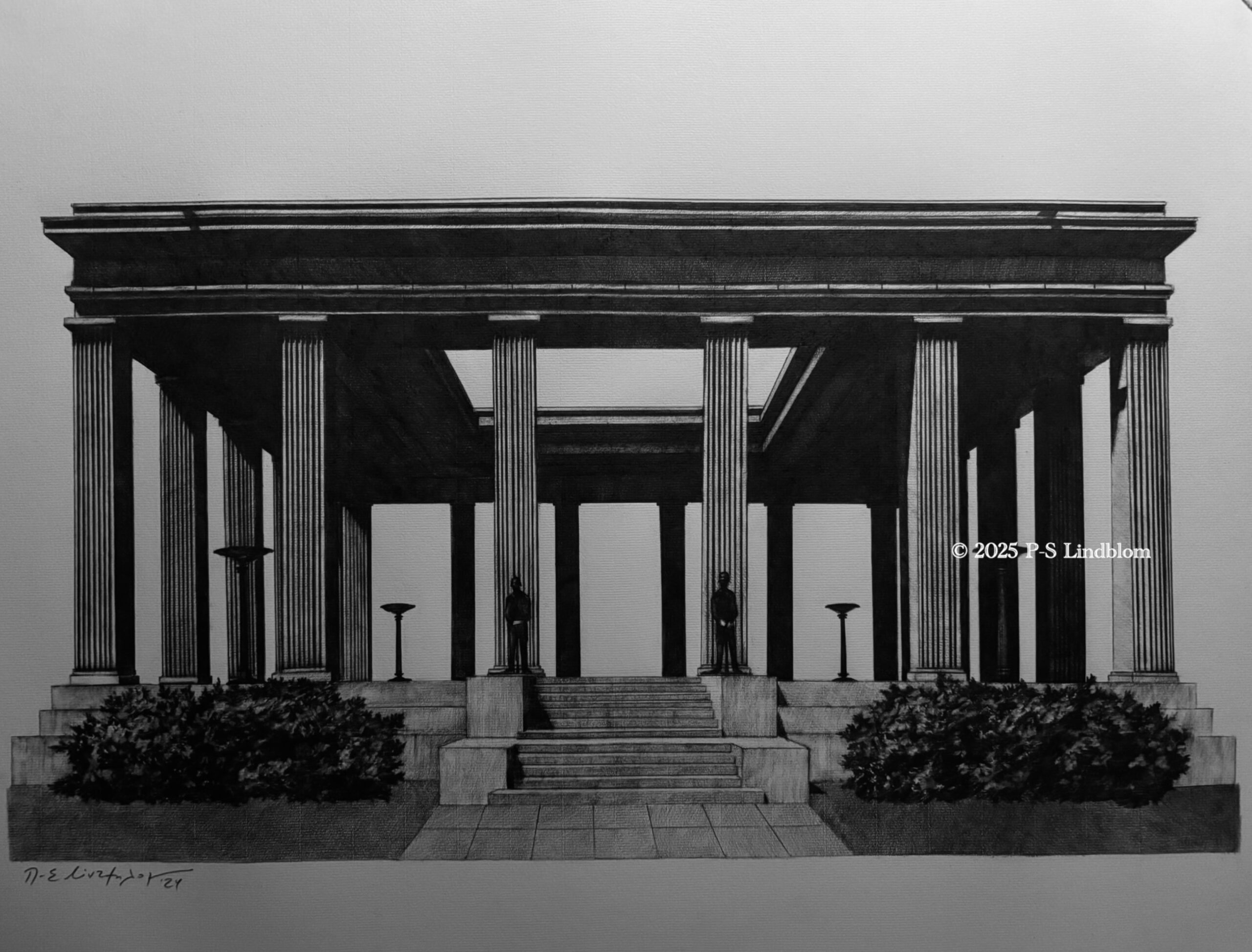
Type: Limited edition prints
Size: 33cm x 48cm / 40cm x 65cm
Tirage: 100 copies each
A pencil drawing of the Honor Temple (German: Ehrentempel) in Munich.
This is drawing n.V of the Reich buildings series.
The Ehrentempel were two identical structures in Munich, designed by Professor Paul Ludwig Troost, and erected by the German Government in 1935, housing the sacrophagi of the sixteen members of the party who had been killed in the failed Beer hall putsch (the Blutzeugen, “blood witnesses”).
In each of the structures eight of the martyrs were interred in a sarcophagus bearing their name. The martyrs of the movement were in heavy black sarcophagi in such a way as to be exposed to rain and sun from the open roof.
Each Ehrentempel was made of limestone except for the roof which was made of steel and concrete with etched glass mosaics. The pedestals of the temples, which are the only parts remaining, are 70 feet (21 m). The columns of the structures each extended 23 feet (7.0 m). The combined weight of the sarcophagi was over 2,900 pounds (1,300 kg).
The temples were guarded by uniformed guards and burning bowls of fire.
On 5 July 1945 the American occupying army removed the bodies from the Ehrentempel and contacted their families. They were given the option of having their loved ones buried in Munich cemeteries in unmarked graves, their family plots or having them cremated, common practice in Germany for unclaimed bodies. The columns of the structures were recycled into brake shoes for municipal buses and new material for art galleries damaged in the war. The sarcophagi were melted down and given to the Munich tram service who used it for soldering material to repair rail and electrical lines damaged by the war.
On 9 January 1947 the main architectural features of the temples were destroyed by the U.S. Army as part of denazification.
The foundation bases of the monuments remain, intersecting on the corner of Briennerstrasse and Arcisstrasse.