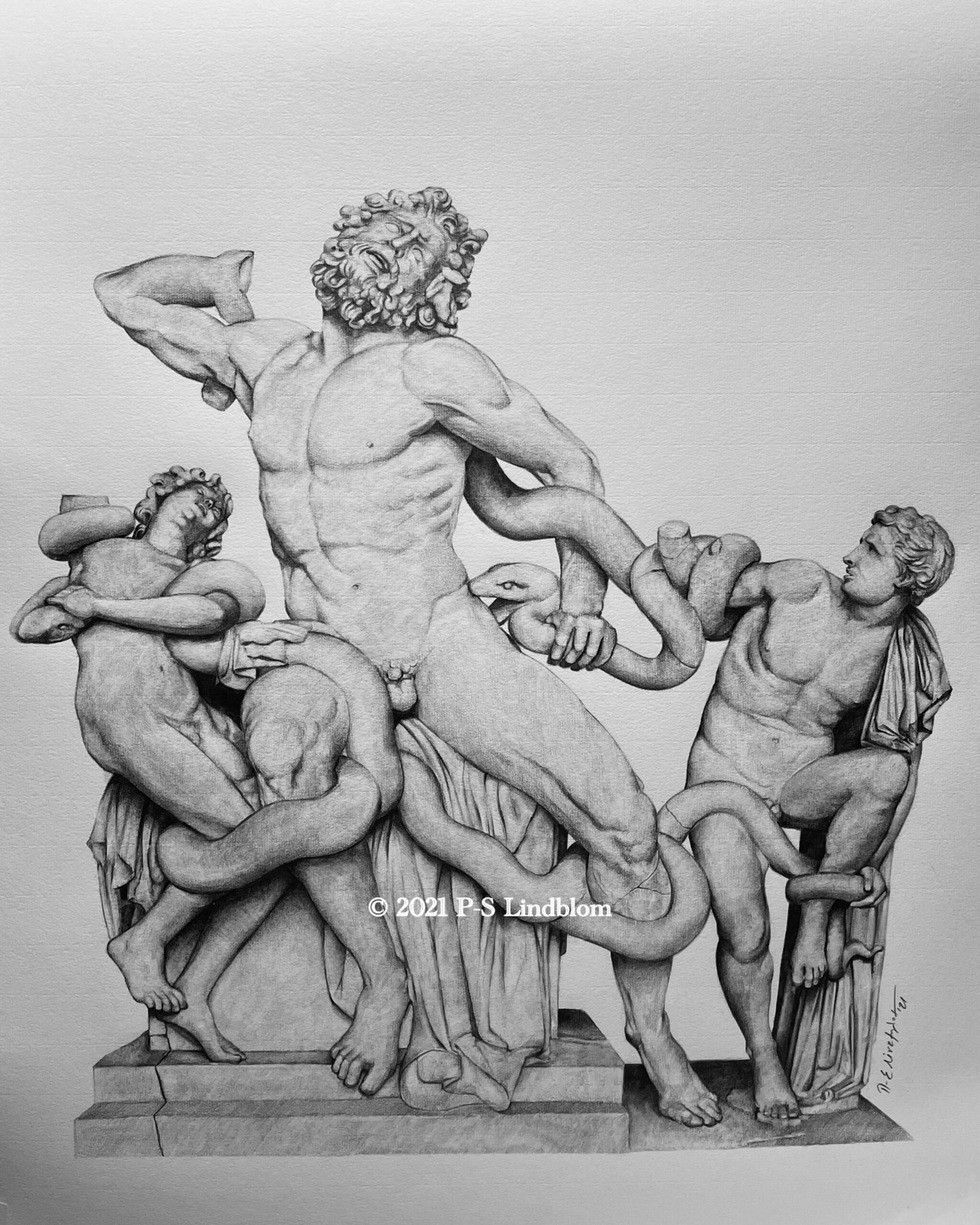
Type: Limited edition prints
Size: 48cm x 33cm
Tirage: 50 copies
A pencil drawing of the statue of Laocoön and His Sons, also called the Laocoön Group, one of the most famous ancient sculptures ever since it was excavated in Rome in 1506 and placed on public display in the Vatican, where it remains on display in the Museo Pio-Clementino.
The style of the work is Hellenistic "Pergamene baroque" which arose in Greek Asia Minor around 200 BC, and whose best known undoubtedly original work is the Pergamon Altar.
Pliny attributes the work, then in the palace of Emperor Titus, to three Greek sculptors from the island of Rhodes: Agesander, Athenodoros and Polydorus, but does not give a date or patron. In style it is considered "one of the finest examples of the Hellenistic baroque" and certainly in the Greek tradition.
The figures are near life-size and the group is a little over 2 m in height, showing the Trojan priest Laocoön and his sons Antiphantes and Thymbraeus being attacked by sea serpents.
The story of Laocoön, came from the Greek Epic Cycle on the Trojan Wars, though it is not mentioned by Homer. It had been the subject of a tragedy, now lost, by Sophocles and was mentioned by other Greek writers, though the events around the attack by the serpents vary considerably. The most famous account of these is now in Virgil's Aeneid.
In Virgil, Laocoön was a priest of Poseidon who was killed with both his sons after attempting to expose the ruse of the Trojan Horse by striking it with a spear. In Sophocles, on the other hand, he was a priest of Apollo, who should have been celibate but had married. The serpents killed only the two sons, leaving Laocoön himself alive to suffer. In other versions he was killed for having had sex with his wife in the temple of Poseidon, or simply making a sacrifice in the temple with his wife present. In this second group of versions, the snakes were sent by Poseidon and in the first by Poseidon and Athena, or Apollo, and the deaths were interpreted by the Trojans as proof that the horse was a sacred object.