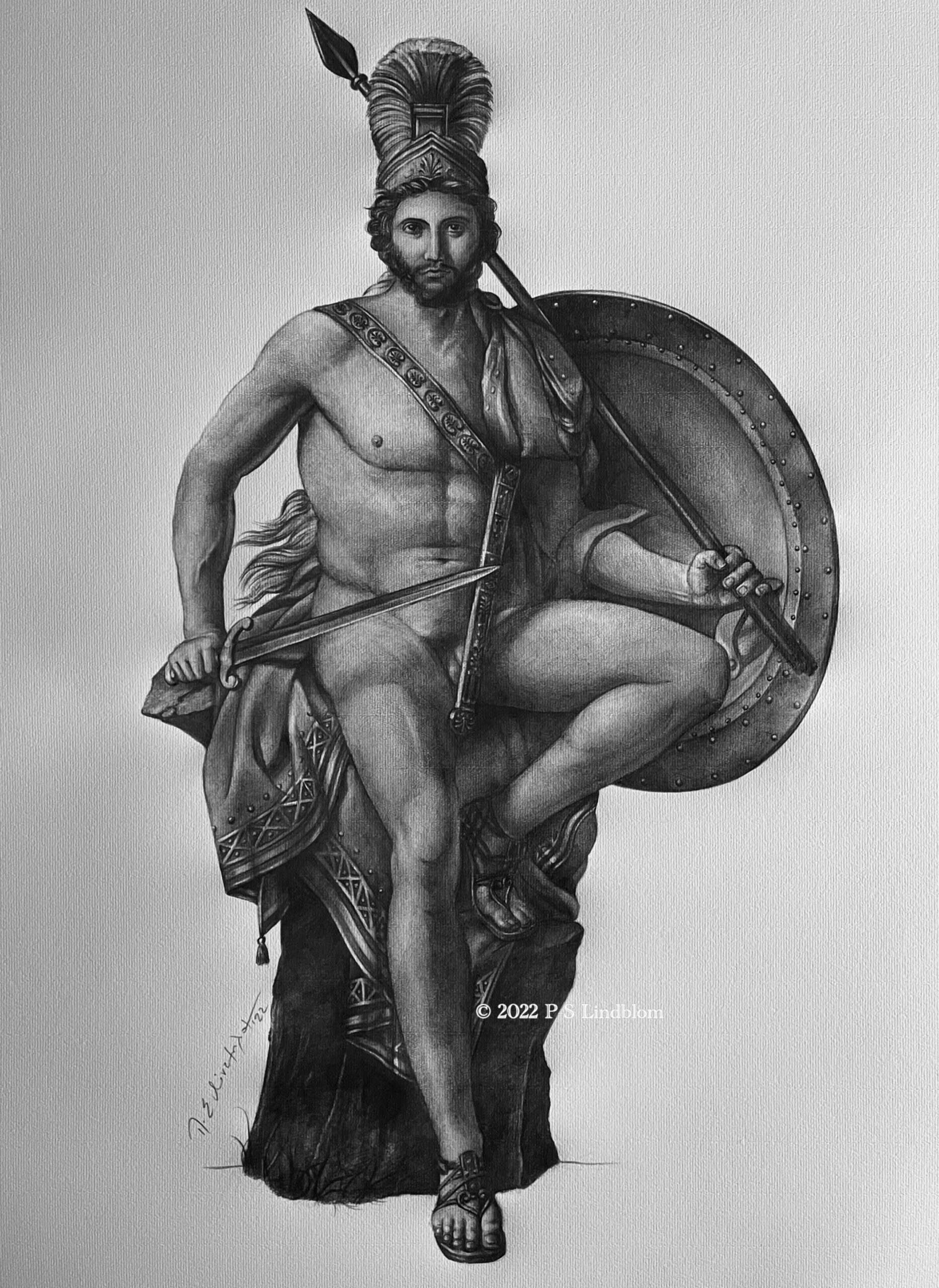
Type: Limited edition prints
Size: 48cm x 33cm
Tirage: 100 copies
Leonidas at Thermopylae is an oil-on-canvas painting by French artist Jacques-Louis David. The work currently hangs in the Louvre in Paris, France. David completed the massive work (3.95 m × 5.31 m) 15 years after he began, working on it from 1799 to 1803 and again in 1813–1814.[1] Leonidas at Thermopylae was purchased, along with The Intervention of the Sabine Women, in November 1819 for 100,000 francs by Louis XVIII, the king of France. The piece depicts the Spartan king Leonidas prior to the Battle of Thermopylae.
In Leonidas at Thermopylae, it is implied that the war is deeper than just the main figures in the foreground, with hundreds of other warriors in the battle too. In the foreground, we see that chaos has broken out and the army seems to be in shambles, while the leader of the army remains calm as the war progresses around him. The emphasized man in the center, presumably Leonidas, instantly draws the viewers’ eyes to him. Not only is Leonidas more bathed in light out of any of the partly shadowed figures in the painting, he also has the most static pose while almost everyone else is in motion. In this brief snapshot of a glimpse into an intense battle, he takes a moment to reflect on the war. While he is the leader of his army, Leonidas cannot do this alone; his eyes are upturned toward the heavens, as if to look up to God and beg for help. His facial expression is one of contemplation and almost defeat, as if he knows the fate of him and his army in the battle.