Type: Limited edition prints
Size: 33cm x 48cm
Tirage: 50 copies
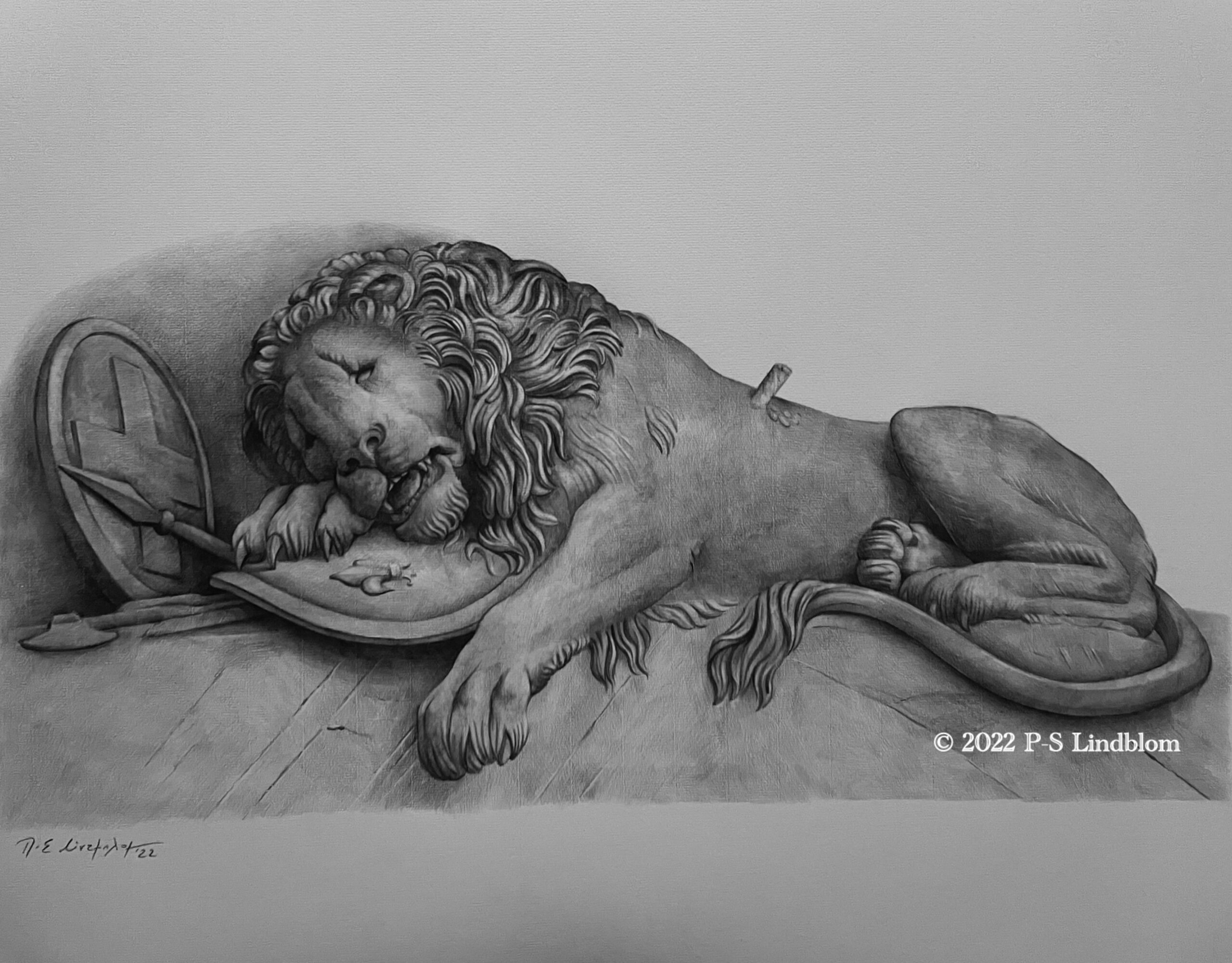
A pencil drawing of The Lion of Lucerne, a rock relief monument in Lucerne, Switzerland. Designed by the Danish sculptor Bertel Thorvaldsen and hewn in 1820–21 by the German stone-mason Lukas Ahorn.
This monument commemorates the Swiss Guards who were massacred in 1792 during the French Revolution, when revolutionaries stormed the Tuileries Palace in Paris.
The initiative to create the monument was taken by Karl Pfyffer von Altishofen, an officer of the Guards who had been on leave in Lucerne at that time of the fight. He began collecting money in 1818. The monument was funded by a number of European Royal houses.
Carved into the cliff face, measures ten metres in length and six metres in height.
The dying lion is portrayed impaled by a spear, covering a shield bearing the fleur-de-lis of the French monarchy; beside him is another shield bearing the coat of arms of Switzerland.
Rather than symbolizing the strength of monarchical power, it was to embody the bravery, fidelity, and courage of the Swiss soldiers
The inscription above the Lion reads HELVETIORUM FIDEI AC VIRTUTI ("To the loyalty and bravery of the Swiss"). The inscription below the sculpture lists the names of the officers and gives the approximate numbers of soldiers who died (DCCLX = 760), and survived (CCCL = 350).
American writer Mark Twain put it: “the most mournful and moving piece of stone in the world”