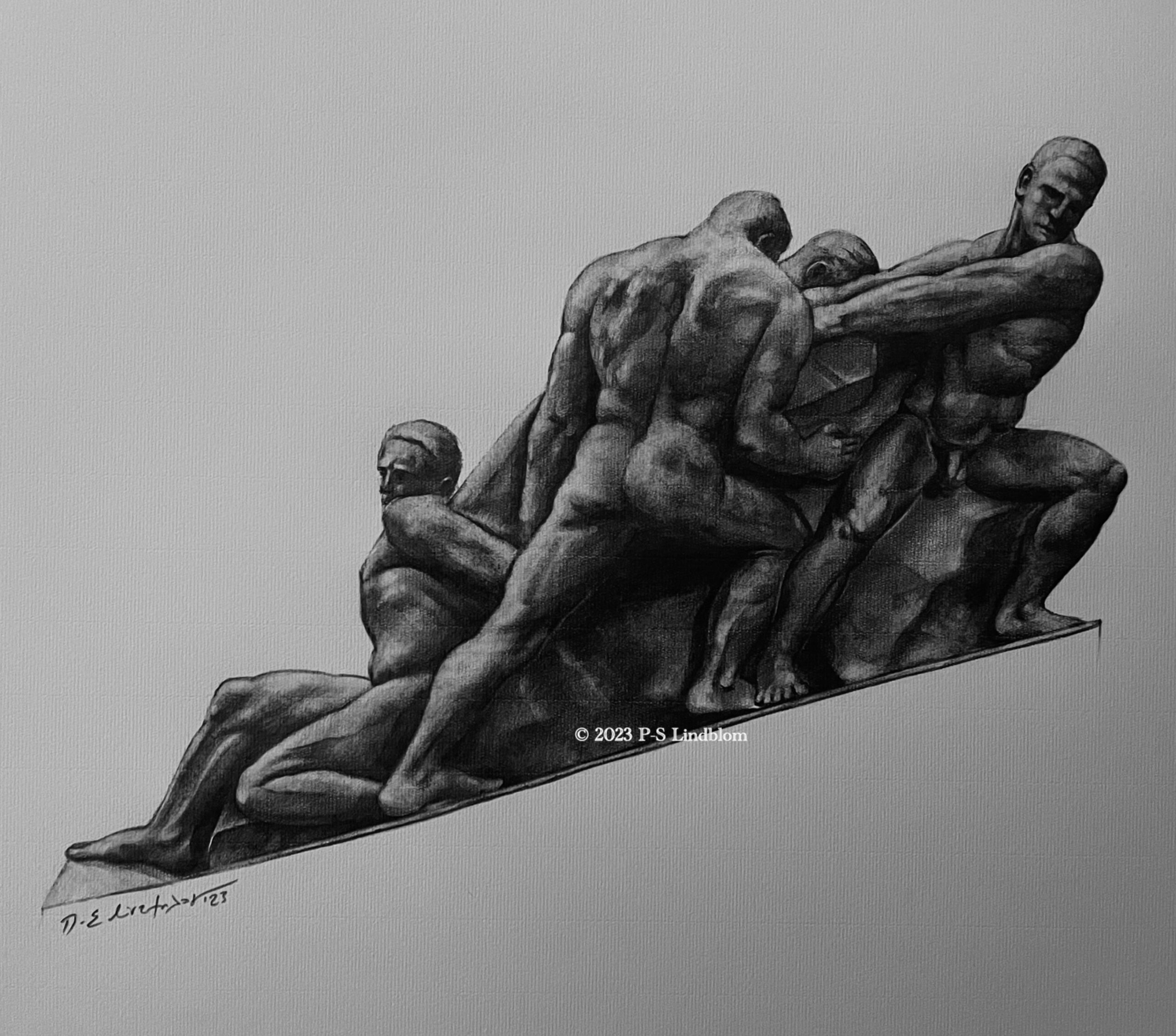
Type: Limited edition prints
Size: 33cm x 48cm
Tirage: 50 copies
A pencil drawing of the maquette of the colossal sculpture “Denkmal der Arbeit für die Reichsautobahn” (English : Monument to Work for the Reichsautobahn) by Josef Thorak.
Designed to grace the central reservation of the newly built Reichsautobahn (Reich motorway) in Salzburg. Planned to be placed in the median on the site of the sod-breaking for the extension of the highway into Austria.
Josef Thorak executed and exhibited in 1938 the model for this gigantic monument to the Reichsautobahn workers.
This was planned to reach a height of 14 meters (45 feet) but unfortunately was never finished.
It depicted four naked workers straining to move a boulder up a slope in a manner recalling Sisyphus. A symbol of comradeship and brotherhood ; together, they form a striking composition filled with symbolism and unity.
The strong aesthetic element to the execution of the project of the Reichsautobahn ; a permanent monument to the Reich, a general promotion of motoring as a modernization that in itself had military applications, a major contribution to the reduction of unemployment, enabling Germans to explore and appreciate their country.
The ceremonial shoveling was held on 23 September 1933, at Frankfurt, and work officially began simultaneously at multiple sites throughout the Reich the following spring. The first finished stretch, between Frankfurt and Darmstadt, opened on 19 May 1935, and the first 1,000 km (620 miles) were completed on 23 September 1936. After the annexation of Austria, the planned network was expanded to include the Ostmark, and a second sod-breaking ceremony for the first Reichsautobahn on formerly Austrian territory took place near Salzburg on 7 April 1938.
When work ceased in 1941 because of World War II, 3,819.7 km (2,373.5 miles) had been completed. with another 2,500 km (1,550 miles) under construction.
After the war, with the exception of the parkway aesthetic, the Reichsautobahn became the model for highways in other countries, and the practical experience gained - in logistics, mechanized construction, and bridge-building - was also used by others.