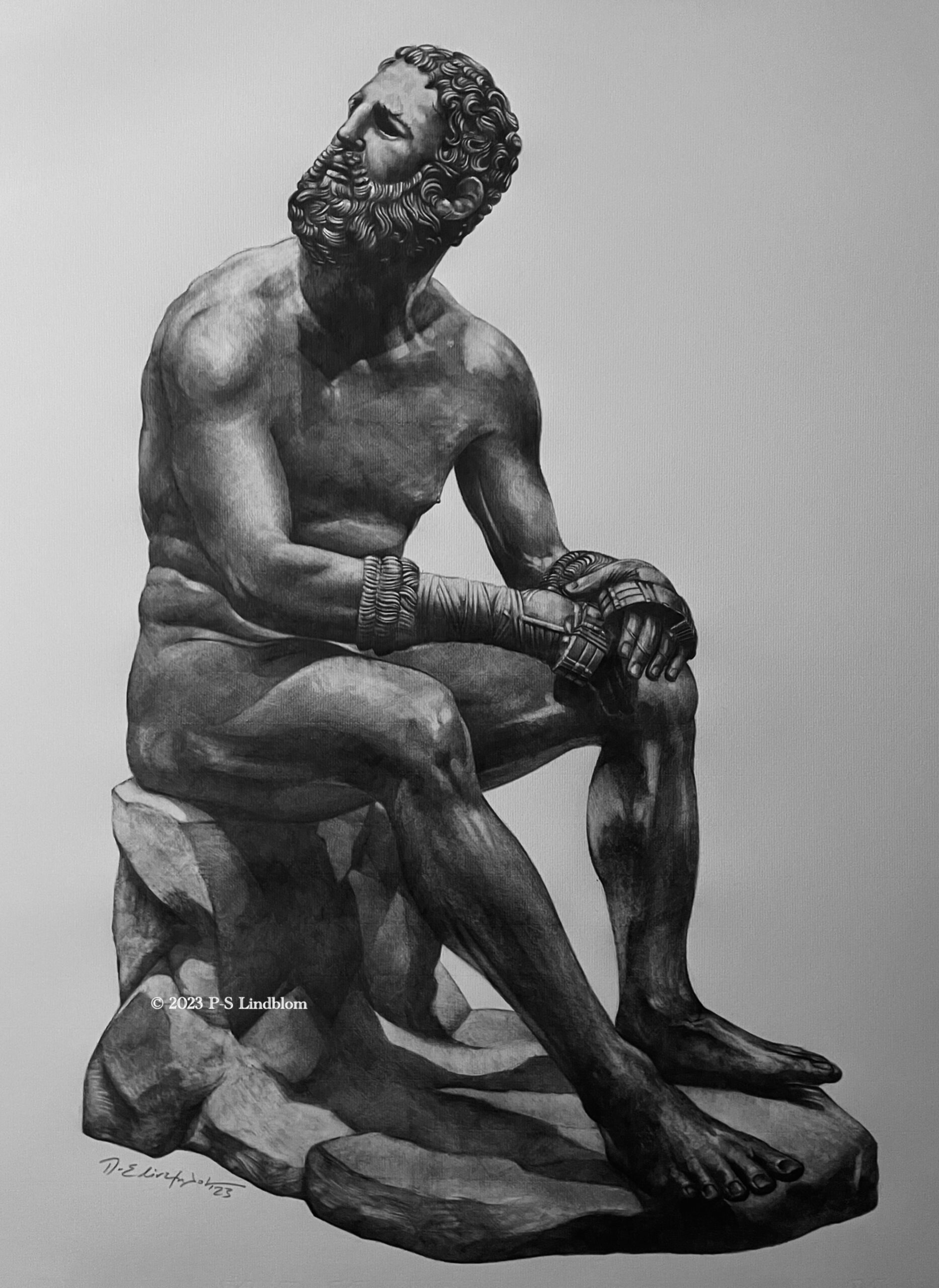
Type: Limited edition prints
Size: 48cm x 33cm / 65cm x 50cm
Tirage: 100 copies / 50 copies
A pencil drawing of The Boxer at Rest, also known as the Terme Boxer, Seated Boxer, Defeated Boxer, or Boxer of the Quirinal. Now in the collection of the National Museum of Rome, normally displayed in the Palazzo Massimo alle Terme.
This is a bronze sculpture, a Hellenistic Greek original, of a sitting nude boxer at rest, still wearing his himantes (Greek: ἱμάντες, plural of ἱμάς, himás, 'a leathern strap or thong'), a type of leather hand-wrap.
Scholars have long debated the date of the statue, which is most likely between the late fourth and the second century B.C. The sculpture is an exceptional work in bronze from the Hellenistic period (323-31 B.C.) and is of outstanding artistic value.
Now in the collection of the National Museum of Rome, normally displayed in the Palazzo Massimo alle Terme.
The bronze statue Boxer at Rest was excavated in Rome in 1885 on the south slope of the Quirinal Hill near the ancient Baths of Constantine, where it is thought to have been displayed. The statue was intentionally buried in late antiquity, possibly to preserve it against the barbarian invasions that ravaged Rome in the fifth century A.D. The broad-shouldered, lanky pugilist is depicted just after a match sitting on a boulder to rest after the unnerving tension of the fight. Something catches his eye and makes him turn his head: perhaps the applause of the spectators or the entrance of his next opponent?
In his athletic nakedness, he wears only boxing gloves and a sort of athletic suspender (kynodèsme) that was both protective and an element of decorum. The many wounds to his head, the primary target in ancient Greek boxing matches, make clear that he has just completed a match. Blood, represented by inlaid copper, drips from cuts on his forehead, cheeks, and cauliflower ears. His right eye is swollen and bruised. His nose is broken, and he breathes through his mouth, probably because his nostrils are blocked by blood. His inwardly drawn lips are scarred, likely indicating that his teeth have been pushed in or knocked out. Despite his exhaustion, the muscles in his arms and legs are still tense, as if the battered champion were ready to spring up and face a new combatant.
The iconography draws inspiration from two statues of Hercules sculpted by Lysippos in the fourth century B.C., thereby associating the momentary rest of a victorious athlete to that of a mythical hero who embodies the ideals of virtue and strength. It is, therefore, possible that the statue was meant to celebrate a mythical or real boxer who was glorified for his endurance and courage.
Scholars have long debated the date of the statue, which is most likely between the late fourth and the second century B.C. The sculpture is an exceptional work in bronze from the Hellenistic period (323-31 B.C.) and is of outstanding artistic value.
The statue was cast using the indirect lost-wax method. It was made in different sections that were then welded together: head, body, genitals, arms above the gloves, forearms, left leg, and middle toes. The top of the head was restored in antiquity. Although the inset eyes are missing, they would have been convincingly rendered.
The statue is remarkable for its extensive use of inlaid copper, especially for the wounds to the boxer's head and the drips of blood on his right arm and leg as well as his lips, nipples, and the straps and stitching of the boxing gloves. Of particular note is the bruise under his right eye, which was cast with a different alloy to give it a darker color. Extensive cold-working of the statue, especially the hair, was part of the finishing process. The stone base is modern but is probably a close approximation of the ancient base. Originally, the use of stone would have added to the realistic effect so powerfully rendered in the bronze.
Areas of the boxer's right foot and hands are worn from frequent touching in antiquity. The statue may have been accorded healing powers, as was known to have occurred with other statues of famous athletes. An Early Imperial vitreous paste ring stone appears to represent the same statue of a boxer sitting on a rock and may have been a talisman for the ring's owner. It is perhaps thanks to its popular veneration that the bronze statue Boxer at Rest was protected so carefully in late antiquity, when the Baths of Constantine were destroyed.