Type: Limited edition prints
Size: 48cm x 33cm / 65cm x 50cm
Tirage: 50 copies each
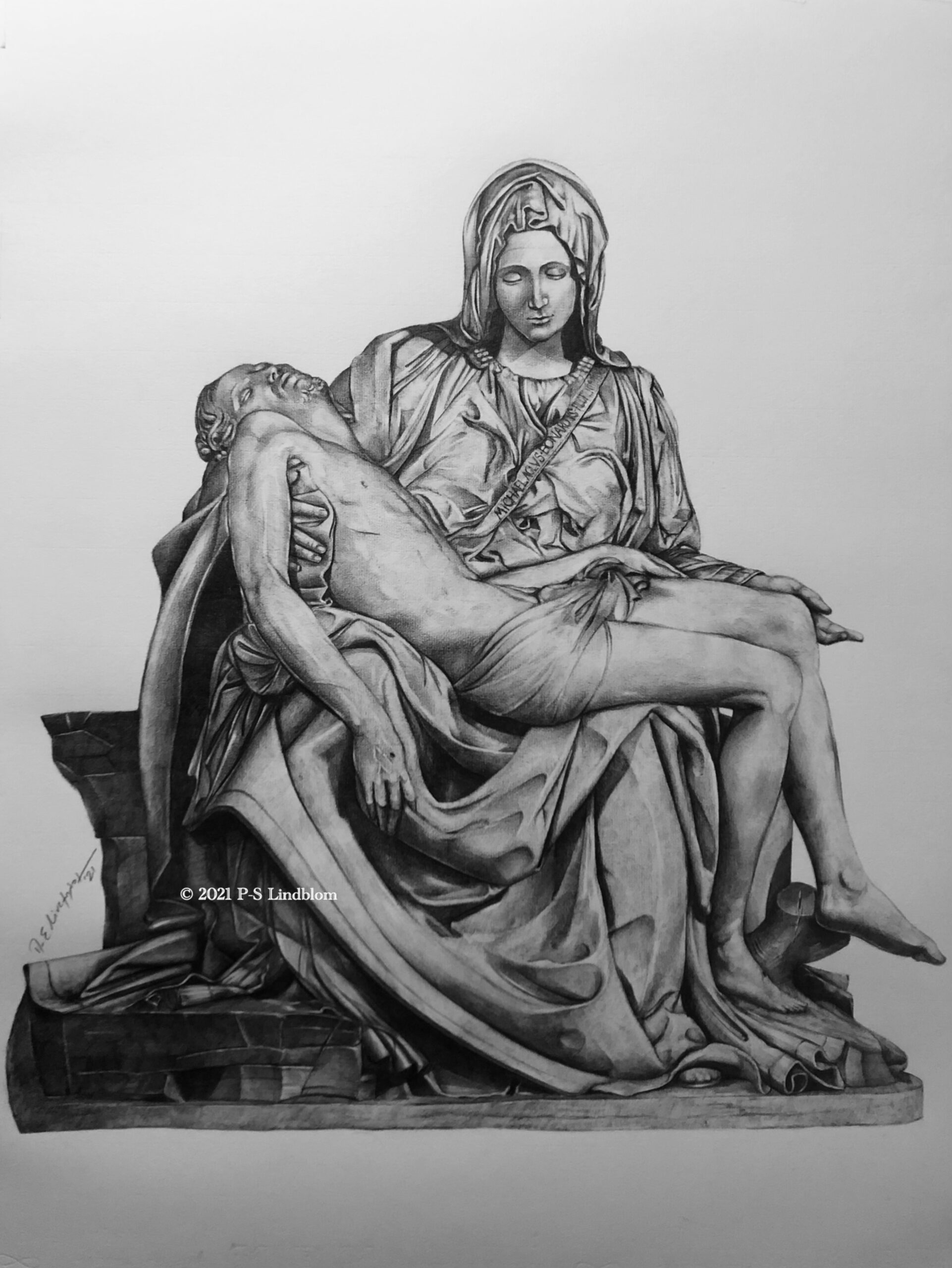
A pencil drawing of The Pietà, a Carrara marble Renaissance sculpture, made by Michelangelo Buonarroti (Il Divino ("the divine one") considered the greatest artist of all time ; 1475 – 1564) at the age of 23, in 1498-1499.
Now in St. Peter's Basilica, Vatican City.
Commissioned for Cardinal’s Jean de Bilhères funeral monument, moved to its current location in the 18th century.
It is the only piece Michelangelo ever signed. He carved MICHAELA[N]GELUS BONAROTUS FLORENTIN[US] FACIEBA[T] (Michelangelo Buonarroti, Florentine, was making this) on the sash running across Mary's chest.
This famous work of art depicts the body of Jesus on the lap of his mother Mary after the Crucifixion. In supporting Christ, the Virgin’s right hand does not come into direct contact with his flesh, but instead it is covered with a cloth which then touches Christ’s side. This signifies the sacredness of Christ’s body.
Christ's face does not reveal signs of the Passion. Michelangelo did not want his version of the Pietà to represent death, but rather to show the "religious vision of abandonment and a serene face of the Son” - (he wanted to create a work he described as "the heart's image").
The marks of the Crucifixion are limited to very small nail marks and an indication of the wound in Jesus' side.
The Madonna is represented as being very young for the mother of an approximately 33-year-old son
In her utter sadness and devastation, she seems resigned to what has happened, and becomes enveloped in graceful acceptance. Michelangelo’s talent in carving drapery is matched by his handling of the human forms in the Christ and the Virgin, both of whom retain a sweet tenderness despite the very tragic nature of this scene.
This is, of course, the moment when the Virgin is confronted with the reality of the death of her son. In her utter sadness and devastation, she seems resigned to what has happened, and becomes enveloped in graceful acceptance. Christ, too, is depicted almost as if he is in a peaceful slumber, and not one who has been bloodied and bruised after hours of torture and suffering.