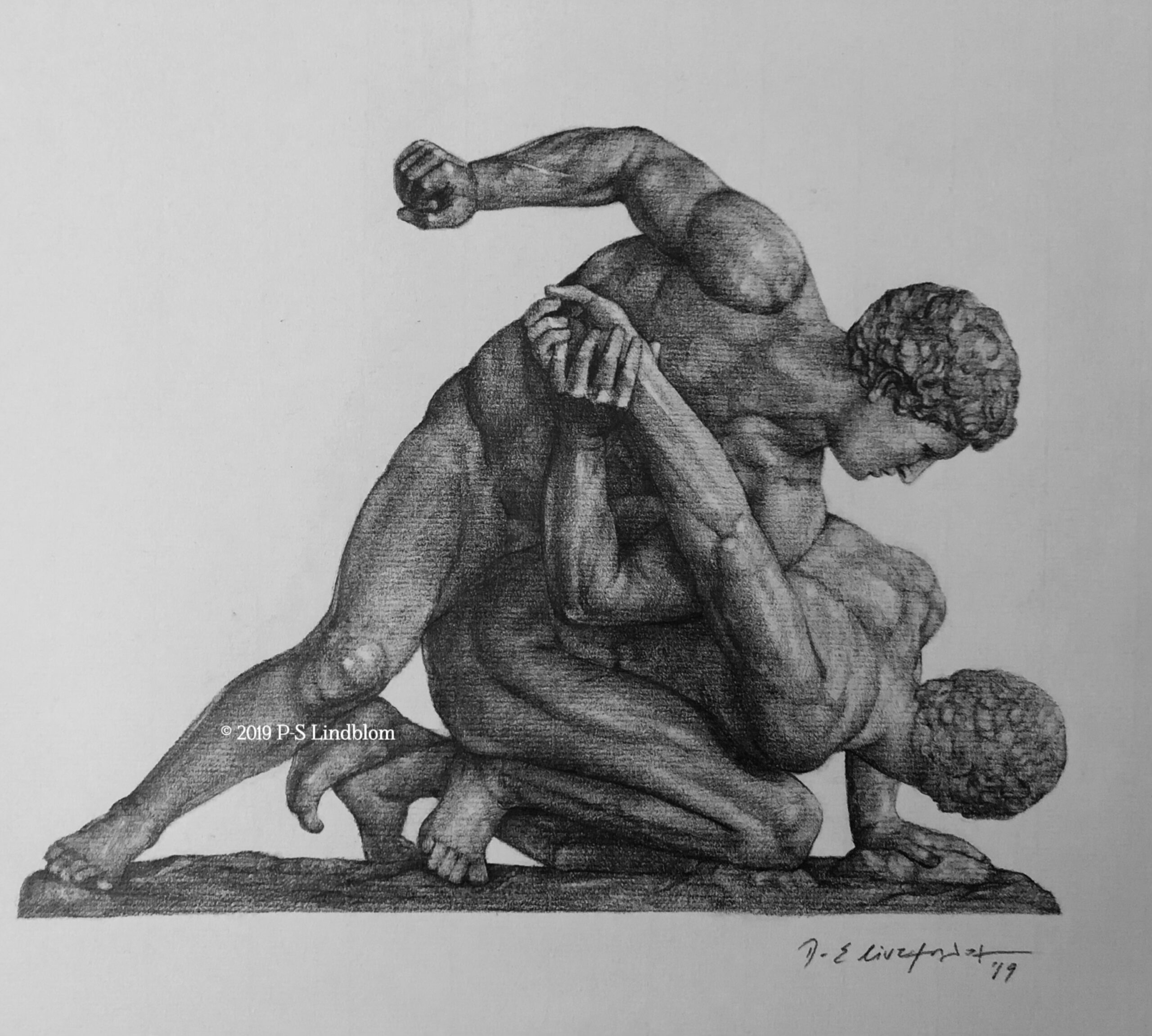
Type: Limited edition prints
Size: 33cm x 48cm
Tirage: 50 copies
A pencil drawing of The Wrestlers (also known as The Two Wrestlers, The Uffizi Wrestlers or The Pancrastinae), a Roman marble sculpture after a lost Greek original of the third century BC. It is now in the Uffizi collection in Florence, Italy.
The two figures are wrestling in a position now known as a "cross-body ride" in modern folkstyle wrestling. The upper wrestler has his left leg entwined with his opponent's left leg, with his body across the opponent's body, lifting the opponent's right arm. In a well-known modern series of wrestling moves, the upper wrestler would now try to lift his opponent's arm above his head to force a pinning move called the "Guillotine." Their muscular structure is very defined due to their physical and sustained effort.
Pankration (Greek: Παγκράτιον) was an unarmed combat sport introduced into the Greek Olympic Games in 648 BC. The athletes used boxing and wrestling techniques but also others, such as kicking, holds, joint locks, and chokes on the ground, making it similar to modern mixed martial arts. The term comes from the Ancient Greek word παγκράτιον (pankrátion), meaning "all of power" (from παν- (pan-) 'all-' and κράτος (krátos) 'strength, might, power').
However, pankration was more than just an event in the athletic competitions of the ancient Greek world; it was also part of the arsenal of Greek soldiers – including the famous Spartan hoplites and Alexander the Great's Macedonian phalanx. It is said that the Spartans at the Battle of Thermopylae fought with their bare hands and teeth once their swords and spears broke.