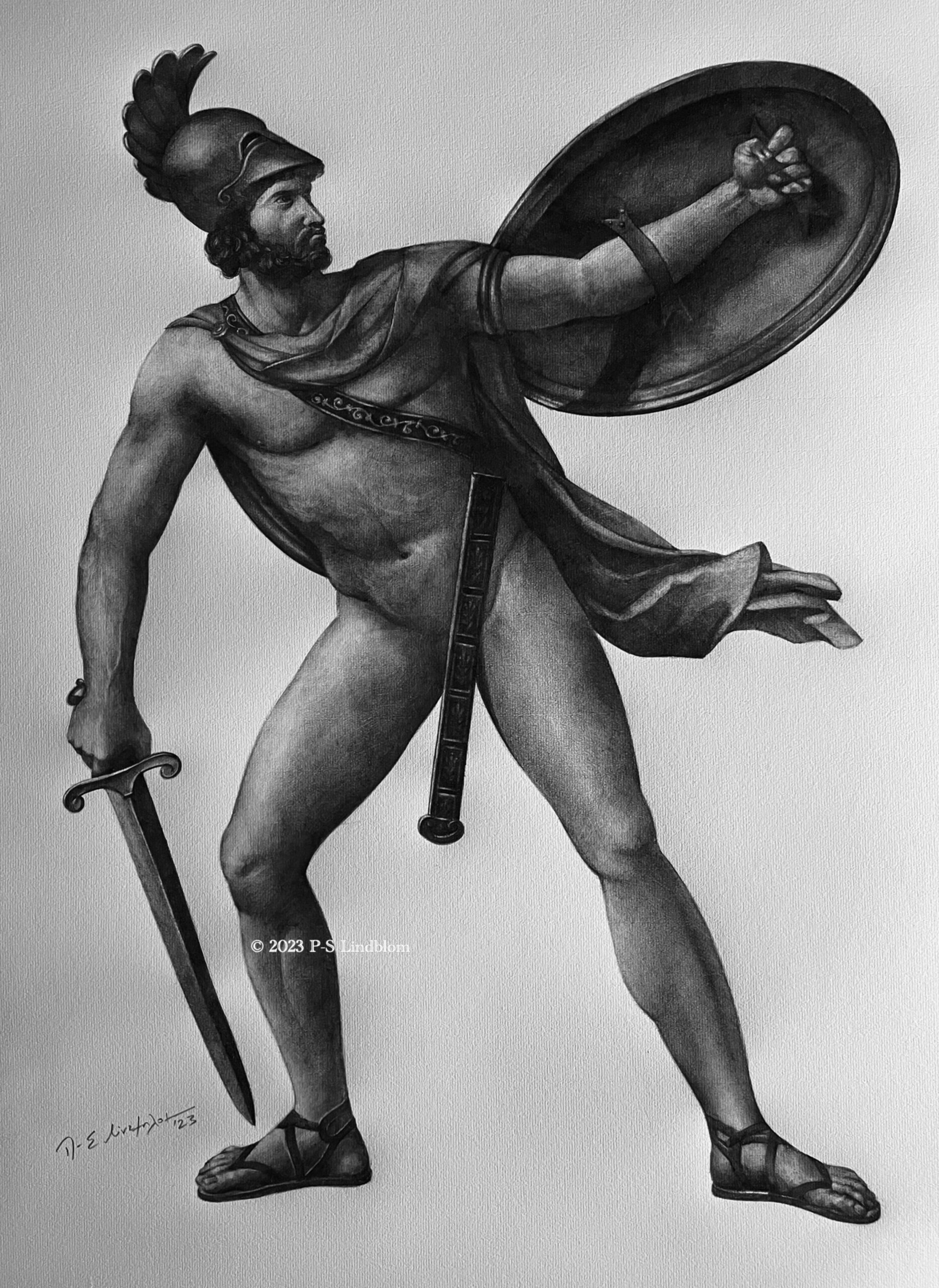
Type: Limited edition prints
Size: 48cm x 33cm
Tirage: 100 copies
A pencil drawing of Titus Tatius, a detail of the painting “The Intervention of the Sabine Women” by the French painter Jacques-Louis David made in 1799, showing a legendary episode following the abduction of the Sabine women by the founding generation of Rome.
The Abduction of the Sabine Women is an episode in the legendary history of Rome, traditionally said to have taken place in 750 BC, in which the first generation of Roman men acquired wives for themselves from the neighboring Sabine families.
Fearing the emergence of a rival society, the Sabines refused to allow their women to marry the Romans. Consequently, the Romans planned to abduct Sabine women, during a festival of Neptune Equester and proclaimed the festival among Rome's neighbours. At the festival Romulus gave a signal, at which the Romans grabbed the Sabine women and fought off the Sabine men. The indignant abductees were soon implored by Romulus to accept Roman husbands.
In the ensuing battle, fought in the valley between the Capitoline and Palatine hills, the Sabine women rushed into the fray, intervened and implored the two warring parties to reconcile and thus stopped the fighting. A formal treaty was drawn up uniting the Romans and Sabines under a dual kingship of Titus Tatius and Romulus.
The painting depicts the height of the conflict, when Hersilia, a Sabine girl, daughter of Titus Tatius, leader of the Sabines, who had become the wife of the Roman General Romulus, throws herself between the combatants (their Roman husbands and avenging Sabine brothers and fathers) and pleaded successfully for an end to this internecine bloodshed.
A moment of compassion in a time of conflict.