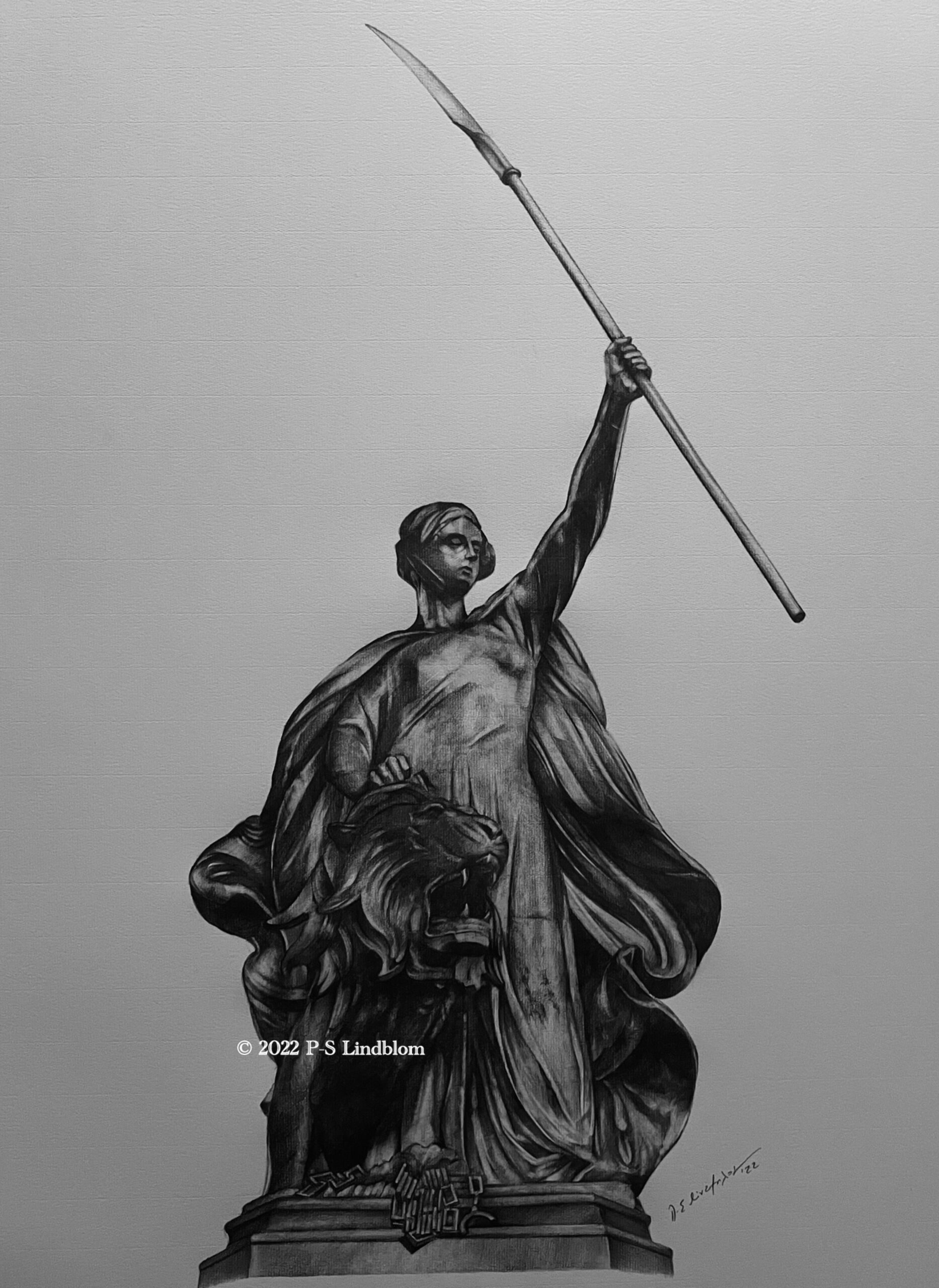
Type: Limited edition prints
Size: 48cm x 33cm
Tirage: 50 copies
A pencil drawing of The 'Maagd van Vlaanderen' (Virgin of Flanders) also known as the Groeningemonument. Designed by sculptor Godfried Devreese. The virgin of Flanders holds a spear in her left hand wich points towards France who was defeated in battle and an unshackled lion in her right hand to symbolise a free Flanders. At the foot of the statue there is also an image of Robert II d'artois, the French captain, fallen of his horse.
This is memorial statue located in Kortrijk, Flanders on the Groeningekouter which was the battlefield of the famous battle of the Golden Spurs.
The Battle of the Golden Spurs (Dutch: Guldensporenslag; French: Bataille des éperons d'or) was a military confrontation between the royal army of France and the Flemish foot army of the County of Flanders on 11 July 1302 during the Franco-Flemish War (1297–1305). The outcome was the unthinkable defeat of the French
When the two armies met outside the city of Kortrijk on 11 July, the cavalry charges of the mounted French men-at-arms proved unable to defeat the mail-armoured and well-trained Flemish militia infantry's pike formation. The result was a rout of the French nobles, who suffered heavy losses at the hands of the Flemish.
The 500 pairs of spurs that were captured from the French horsemen gave the battle its popular name. The battle was a famous early example of an all-infantry army overcoming an army that depended on the shock attacks of heavy cavalry.
It soon became connected to nationalist ideals because the Middle Ages were "a period that could be linked with the most important contemporary aspirations" of romantic nationalism. As the Battle of the Golden Spurs became an important part of Flemish identity, it became increasingly important within the Flemish Movement. Emerging in the 1860s, this sought autonomy or even independence for Flemish (Dutch)-speaking Flanders and became increasingly radical after World War I. The battle was seen as a "milestone" in a historic struggle for Flemish national liberation and a symbol of resistance to foreign rule.