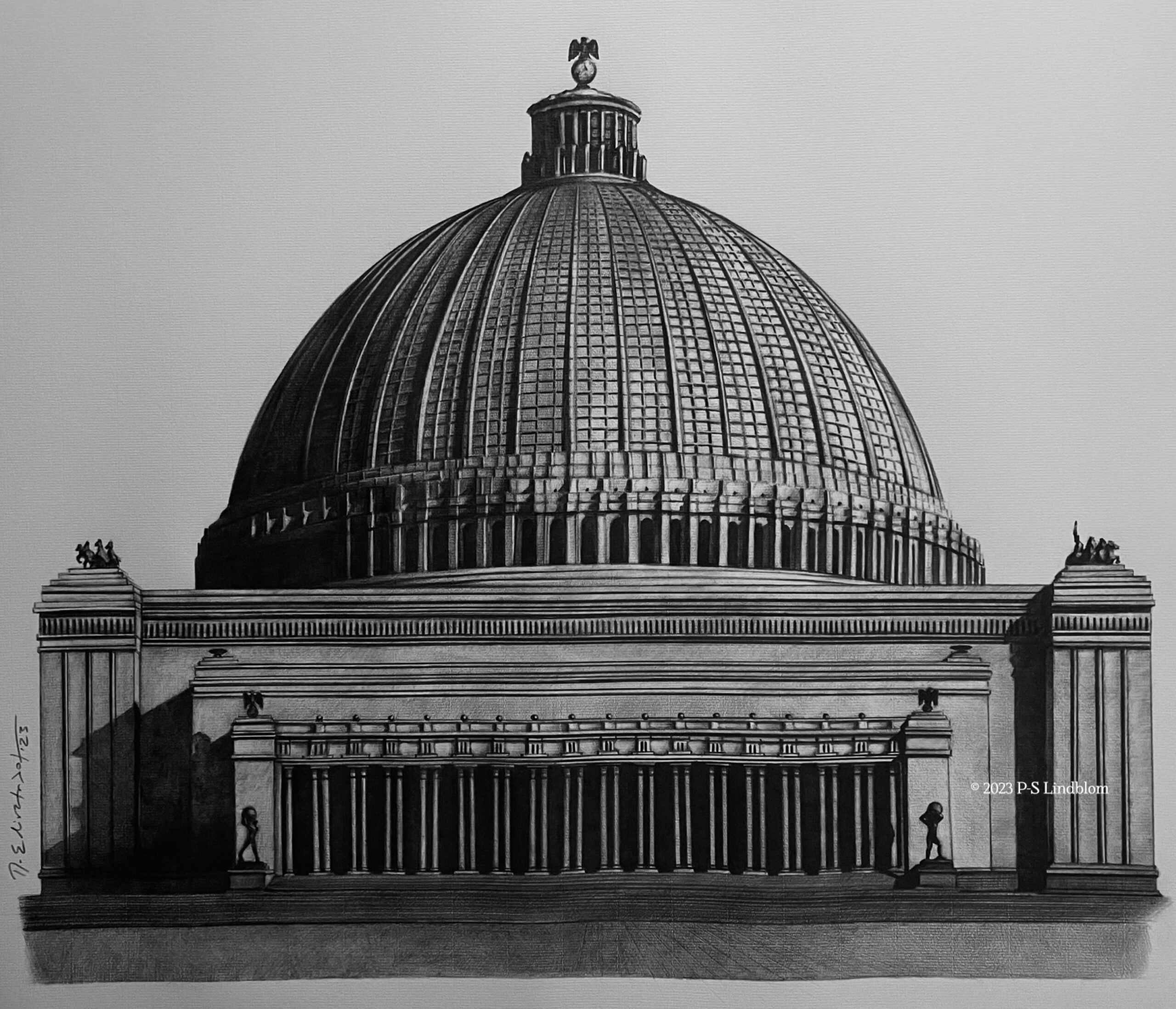
Type: Limited edition prints
Size: 33cm x 48cm / 50cm x 65cm
Tirage: 150 / 50 copies respectively
A pencil drawing of one of the largest buildings planned to be created in the history of man, the Volkshalle (People’s Hall) also called Große Halle (Great Hall), a massive architectural project envisioned by The Austrian Painter and led by his architect, Albert Speer. This building was the most important project of the entire regime of NS Germany which was to be the center of the new Welthauptstadt Germania.
The inspiration for the structure had come from Hadrian's Pantheon located in Rome, Italy, which encouraged a similar shape and structure to the Volkshalle, especially the feature of the dome.
In 1925, The Austrian Painter had made a sketch which he visioned as the greatest architectural project of his life. It copied similar Roman features but far from what it was projected to become - it was the beginning of something great. When he visited Rome in 1938, he went to the Pantheon and mentally blueprinted the structure to his hall. The beginnings of the Volkshalle began here, in an eloquent room, in the head of an artist. In a recorded conversation about the Pantheon between Hermann Geisler and The Austrian Painter, he said
"From the time I experienced this building - no description, picture or photograph did it justice. I became interested in its history. For a short while I stood in this space (the rotunda) - what majesty! I gazed at the large open oculus and saw the universe and sensed what had given this space the name Pantheon - God and the world are one.”
The oculus of the dome, 46 metres in diameter, would have accommodated the entire rotunda of Hadrian's Pantheon and the dome of St. Peter's Basilica. The dome was to rise from a massive granite podium 315 by 315 metres & 74 metres high, to a total inclusive height of 290m. The diameter of the dome 250m.
The hall itself being capable of holding up to 200,000 people. The podium was to be made entirely of granite; the north-end of the building was to be surfaced in gold mosaics (similar to the Golden Hall at Nuremburg) and 100 marble pillars at 79 meters in height were to be placed by the tiers of seats.
A colossal statue of Atlas holding up the Cosmos and another of Tellus holding up the Earth were proposed by Breker.
No part of the building was ever constructed.